
FSOO 2025 Spotlight: Benjamin Morris & Laura Fuentes
Meet the composer and librettist of Las Auténticas, one of the three winning micro-operas for FSOO 2025!
Often the most poignant and powerful dialogue happens between those who create and those who perform. That’s why OOO connects our singing-artists with the composers and librettists selected for the 7th Annual Fresh Squeezed Ounce of Opera.
If you’re curious about the story inspiration, what to listen for, what to expect, and more, you’re in the right place.
Here, get the scoop behind the story of Las Auténticas, written by Benjamin Morris (composer) & Laura Fuentes (librettist) – with questions from the cast – designed to enhance your experience. Bonus: you will be among the very first to hear this work, making its Regional Premiere!
First, a quick synopsis:
Jenny and her aunt Luz run a taco stand that has been named as a finalist for a social media influencer’s Most Authentic Taco title. As they await the influencer’s visit and final verdict, Jenny questions her cultural legitimacy as a first-generation Mexican-American, as Luz hearkens back to lessons learned from a lifetime of punk rock fandom. Who determines authenticity? How far should we lean into others’ expectations? Whose tacos will emerge victorious?
Is the taco truck Luz’s taco truck and Jenny is just helping her or is this the family business?
Laura: Great question — the taco truck is named “Taquería Dos Hermanas,” and we know that Luz and Jenny aren’t sisters, but rather aunt and niece. My thought was that Luz had originally been in business with her sister (possibly Jenny’s mom), and that Jenny is stepping into a role in the business later. This is another example of the theme of appearances versus reality, which ties into our theme of authenticity. At one point, I remember counting ~18 different instances of how this theme plays out across the piece in both small and large ways — see if you can spot them all! 😉
Ben: When Laura told me that Jenny’s mom was possibly the former co-owner of “Taquería Dos Hermanas,” it illuminated a moving and meaningful subtext for me personally. I lost my mom in 2015, and she was my main connection to my Norwegian heritage. Right after my mom passed, I moved to Norway for a year, and I felt a personal disconnect to my heritage and isolated from the culture. Eventually I found my own way to connect to that part of my background through music and immersion in the culture.
Although the exact details are left open, the hole left by Jenny’s mom or Luz’s sister is a strong presence in the piece. Jenny describes herself as a “distant daughter.” This is of course a metaphor, but it also raises a literal question…. Did Jenny’s mom pass away? Are they living far apart? Is their relationship strained? I think listeners can come up with their own interpretation and add layers of subtext to the story. It’s a unique and traditionally unexplored relationship in contemporary opera—an aunt and her niece, rather than a mother and daughter. I think the open-ended personal relationship between Jenny and Luz add dimensions to the piece.
I love how you explore Luz’s relationship to authenticity through punk, a genre predicated on authenticity and personal identity. Do you have a relationship to Mexican punk music, and how did that influence Luz’s character? Also, are there any cool bands I should look up?
Laura: Thanks so much! I love indie music in all its forms, and punk definitely has a special place in that scene. For Luz, I think punk fandom helps lend her a Gen X-style swagger, contrasting with Jenny’s greater self-consciousness.
In terms of recommendations, I’m a big fan of the radio show The Latin Alternative, which airs on our local independent radio station and many others nationwide. Alt.Latino is also great for keeping up to date on new music!
https://www.npr.org/podcasts/542771035/the-latin-alternative
https://www.npr.org/sections/altlatino/
Ben: I leaned into the punk music ethos in Luz’s aria, “Era Un Grapito”: there are syncopated riffs, power chords, and extended vocal lines. I think punk and opera overlap nicely — both feature big sounds and have a tinge of rebellion to them. I’m also a fan of blending and blurring genres in opera to reflect the identity of characters—in Las Auténticas, there’s Mariachi mixed with musical theatre and punk. Laura and I listened to a lot of music together as we worked on this piece, but I particularly remember hearing “Contaminado” by the band Ritmo Peligroso. It’s a cool song that blends the punk attitude with Latin percussion and brass and piano montunos.
I also closely consulted with my friend, Mexican American composer and lyricist Nevada Lozano, and Laura’s husband Sebastian, who both helped me set Spanish text in an idiomatic and respectful way.
Jenny sings about an orange tree in Nuevo León and then commiserates about having never grown one herself. Why does she latch onto this symbol specifically, and what does it mean to her?
Laura: The northeast of Mexico is a major orange-growing region, and I like the idea that Jenny’s family has a history that is tied to the land in a very tangible way. I think that as cultural diasporas become more temporally and generationally removed from their land of origin, there can sometimes be a sense of longing for grounding symbols like these. In the case of the oranges, I also wanted to invoke imagery around “one big orange” (the sun) shining over both Jenny in the US and her family’s land of origin, while the “many little ones” are all in Mexico.
Ben: Jenny’s aria “Today the Sun Rose” evokes elements of the traditional musical theatre “I want” song. When Jenny sings “I’ve never grown an orange,” she feels that she can’t own up to her identity, that she’s inauthentic, in a way, and she wants to feel connected to her heritage. I like Laura’s pastoral imagery and depict that in the music with soaring melodic phrases. It’s a nice metaphor for anyone that feels like they must “perform” their own cultural identity.
Who is Don Ernesto? Does he represent anyone in particular?
Ben: Don Ernesto is a loyal customer of Taquería Dos Hermanas. His presence on the phone bookends the opera—in the beginning, Luz is more concerned with making Don Ernesto a great taco, while Jenny is concerned with impressing Gary, or “Esteban Eats,” the judge of the Most Authentic Taco Competition, who is really a hollow social media influencer. In the end, Don Ernesto is impressed with Jenny’s taco-making efforts. It was fun to set Don Ernesto using phrases in the piano, imagining someone grumbling on the other side of a phone, giving the cast something fun to interact with rhythmically.
Laura: To me, Don Ernesto represents the most stereotypical exemplar of “authenticity,” so there’s some fun subversion in the fact that he orders his tacos with Cheez Whiz. In a way, I think Don Ernesto and Luz both feel secure enough in their cultural identities to bend convention a bit, in contrast to Jenny, who feels a profound gulf between herself and her family’s culture of origin.
Enjoy One Ounce Opera’s live recording of Las Auténticas
Get the inside scoop from the cast – watch below!
This project has been funded in part by the Cultural Arts Division of the City of Austin Economic Development Department.
Searching for past performances, photos, or videos? Visit our Facebook, YouTube, and Instagram for archives of our work.

FSOO 2025 Spotlight: Lisa Neher and Caitlin Vincent
Meet the composer and librettist of Beyond, one of the three winning micro-operas for FSOO 2025!
Often the most poignant and powerful dialogue happens between those who create and those who perform. That’s why OOO connects our singing-artists with the composers and librettists selected for the 7th Annual Fresh Squeezed Ounce of Opera.
If you’re curious about the story inspiration, what to listen for, what to expect, and more, you’re in the right place.
Here, get the scoop behind the story of Beyond, written by Lisa Neher (composer) & Caitlin Vincent (librettist) – with questions from the cast – designed to enhance your experience. Bonus: you will be among the very first to hear this work, making its World Premiere!
First, a quick synopsis:
Consider what waits for you beyond that door. A glimpse of one possible future for humanity in the stars, this short work is a compelling meditation on life, death, the cycle of oppression, and what it means to be truly human.
What was the initial germ of an idea that evolved into this opera?
Lisa: I’m a big science fiction fan and it’s a genre I would love to see more in opera and classical music. Sci-Fi is a fabulous genre for asking questions, or telling new stories that aren’t stuck in old gender and identity tropes, and for expanding the opera canon of characters for all voices, especially for sopranos and mezzos, who are underused in standard repertoire. There are so many developments happening right now with “artificial intelligence” / large language models and technology used in our daily lives that it felt relevant to extrapolate that into a future society that relies on androids as its working class laborers. We were both interested in how a story about androids and their sentience and self-determination could reflect many topics we care about, from workers rights to the rights of undocumented people to our relationship to technology.
Caitlin: Lisa and I are both big science fiction fans and we were really intrigued by the possibilities for bridging sci-fi and opera. This particular idea evolved in response to a 2022 call for proposals for a “micro-opera” for two female voices. Lisa suggested that we explore something futuristic involving space travel, and I used the germ of that idea to develop a storyline about two androids waiting to be decommissioned.
Did the libretto come first or did they evolve at the same time?
Caitlin: In all of my collaborations, I always write the libretto first. This gives me an opportunity to map out the structure and pacing of the opera’s story and also incorporate the nuances of each character into the text. After I finalized a draft of the libretto for Beyond, I handed it off to Lisa so she could start developing the musical language. Throughout the process of composition, we remained in close contact and worked through a number of additional changes and rewrites in the process of her setting the text to music.
Lisa: Caitlin wrote the libretto first before I composed the music. For a short opera, I find it particularly important that the libretto is written and workshopped first, because it will inspire and dictate the form and pacing of the piece. Seeing the entire story helps me to structure the length of arias and duets, pacing of exposition versus action musically, and to create motives that express the characters and can evolve with them as they change during the story.
What caused humans to leave earth?
Lisa: One of the things I appreciate about Caitlin’s libretto is that it leaves us with so many more questions than answers! My sense as we were working on the piece was that the Earth has become unlivable due to climate change and pollution, or overpopulated to the point where a group of humans needed to find a different location to thrive.
Caitlin: As I was writing this text, I imagined humans being forced to leave earth because of a climate change disaster. However, as Lisa suggests, it really could be any kind of apocalyptic event! The key is that humans were forced to go…it wasn’t an intentional choice. And in their desperation to ensure the survival of the human race, they made decisions that gradually stripped away their humanity, including building what essentially amounts to a slave population.
Why did they keep building androids after figuring out they were sentient and would need to be destroyed?
Caitlin: Because of the length of the journey and the technological complexities of maintaining a space fleet, the humans need the androids to survive. However, as soon as they realized the androids had grown sentient, they did begin to “clean house”: culling the majority of the older generations and replacing them with younger models that hadn’t yet reached sentience. This is one of the reasons for 142-6’s bitterness: they’re one of the few surviving androids from those early generations. What has changed—and what we’re capturing in Beyond—is that humans are now finally approaching their destination and have decided to dismantle the entire android population before landing on the site of their new colony.
Lisa: Space travel to any potentially habitable world would take many years, so my sense is that the trip is quite long and humans on the voyage needed workers that weren’t human. Perhaps humans are in deep hibernation or something of that sort, due to the far distance of the new colony. So there is a need for labor until they get to the colony–but as we discover, the timeline has been moved up, so the humans must be close to where they are going to settle and want to “clean up” any loose threads.
We know how 142-6 and 503-2 find each other. How did you find each other (Lisa and Caitlin)?
Lisa: I’ve been aware of Caitlin’s work for a while now. We were introduced by composer Tom Cipullo, who was my mentor in the National Association of Teachers of Singing Composer Mentorship program a few years ago. Since then, we’ve written a song cycle about climate change, “Honeyed Voices,” commissioned by Cristina Gallo for her Siren Songs project, and a choral work, “I dug up a rose”, commissioned by Porter-Gaud School in honor of 50 years of the school being a co-educational institution. It’s so wonderful to work with Caitlin because she has a specific theatrical vision for her words and she writes in such a character-driven way. I come from a background in theatre, and that gives us a common frame of reference for storytelling through opera and beyond.
Caitlin: Lisa and I have a number of mutual connections, and I’ve been a long-time admirer of her work. We had our first official “meet and greet “ via Zoom back in 2022 and have since collaborated on three pieces together!
Watch One Ounce Opera’s live recording of Beyond:
Go beyond about Beyond! Get the scoop (and possible spoilers?) in this short vid below!
This project has been funded in part by the Cultural Arts Division of the City of Austin Economic Development Department.
Searching for past performances, photos, or videos? Visit our Facebook, YouTube, and Instagram for archives of our work.

OOO makes the list 3x – KMFA's Top 12 of 2024
Breaking news! OOO Makes the List 3x!
Capping off a banner year, another sweet surprise!
One Ounce was a featured part of three productions mentioned in KMFA Classical 89.5’s Top 12 Classical Highlights of 2024. In chronological order, here’s where we made the list (and links if you’d like to relive any of these moments):
- 6th Annual Fresh Squeezed Ounce of Opera, our flagship micro-opera showcase from February & March of 2024
- 2nd Annual Here Be Monsters Festival, a weekend-long celebration of the Austin indie-classical community
- 2024 Opera Austin Festival, a community-building event featuring new opera producers in Austin (and beyond)
It’s not lost on us that:
- Austin possesses a large and active enough classical scene that it deserves its own Top 12 list (because of folks like you)!
- OOO has had a (fortunate and humble) front row seat to this community’s rise over the past 12 years, and thinking back on that legacy fills us with even more hope for the future.
We will continue to dedicate ourselves to reimagining opera in unexpected spaces, bringing us together for moments of laughter, respite, and community.
Being part of KMFA’s Top 12 of 2024 list (thrice!) means so much to us. Thank you to KMFA for your uplifting support, and for all your team does to feed this extraordinary classical ecosystem here in the Cap City.
This project has been funded in part by the Cultural Arts Division of the City of Austin Economic Development Department.
Searching for past performances, photos, or videos? Visit our Facebook, YouTube, and Instagram for archives of our work.

7th Annual FSOO
Immerse yourself in dynamic storytelling


Experience Austin’s annual micro-opera showcase – one of the most anticipated and award-winning indie-classical events of the season!
One Ounce Opera reviewed over 50 works submitted from all over the world to line up an engaging program of three (3) new micro-operas that will transport you with the sonic tellings of connective, transformative, oh-so-human stories.
Short stories that feel NOW. Dynamic. Familiar, yet…not.
And we welcome you to experience all three winning micro-operas in a single 70-minute program: The 7th Fresh Squeezed Ounce of Opera [FSOO]!
Who is FSOO for? EVERYONE. Here’s a great place to jump in:
In-person audience information, in case you’re curious:
Hey, curious arts lover! Overall, what should you expect at FSOO? A super low-lift evening! Our annual showcase is a great escape, regardless of your previous experiences with opera. Three brand new, dynamic works sung in ~20 minutes each, in English (with a little bit of Spanish!), performed by fellow Austinites in an intimate, immersive, warm, welcoming, and unexpected space. General admission seating means you choose your own adventure. And a complimentary bar, featuring Live Oak Brewing and other tasty bevs, rounds out your experience.
Only 80 available seats per show, so act fast. Recommended for ages 8 and up.
FSOO is presented at our showcase home, DADALAB (2008 Alexander Ave, 78722)! Tickets are available by suggested donation. We highly recommend getting a seat online because we often sell out; however, any remaining seats will be sold at the door.
Las Auténticas
music by Benjamin Morris
libretto by Laura Fuentes
“The Most Authentic Taco in LA,” eh? Join Jenny and her Tía Luz the moment they hear from the “Lord of Tortillas” himself – Esteban Eats – and prepare their food truck for a day they’ll not soon forget. ¿Porqué no hacemos unos tacos?
Luz – Sandra Mercado
Jenny – Annisha Mackenzie
Esteban/Gary – Julius Young

Ray Bradbury, Age 12, at the Carnival in Waukegan, Illinois
music & libretto by Tyler Mabry
The true story, as (very) often told by beloved American author Ray Bradbury (Fahrenheit 451, Something Wicked This Way Comes, The Martian Chronicles), of the mysterious, fantastical Dill Brothers Circus that sparked his interest in becoming a writer. A cascading carousel of wonder!
Ray Bradbury – Nicholas Flott
Mr. Electrico – Jake Jacobsen
Young Ray – Hillary Schranze
Zara/Tattooed Man – Kaley Williams
Calista/Others – Sandra Villwock

Beyond
music by Lisa Neher
libretto by Caitlin Vincent
Consider what waits for you beyond that door. A glimpse of one possible future for humanity in the stars, this short work is a compelling meditation on life, death, the cycle of oppression, and what it means to be truly human.
142-6 – Patricia Combs
503-2 – Andréa Ochoa
Stage Director & Producer: Julie Fiore
Music Director & Pianist: Joseph Choi
Technical + Lighting Director: Matt Smith
Assistant Director: Carol Brown
Stage Manager: Monica Kurtz
KMFA Classical 89.5 – Media Sponsor

Live Oak Brewing – Beer Sponsor
This project has been funded in part by the Cultural Arts Division of the City of Austin Economic Development Department.
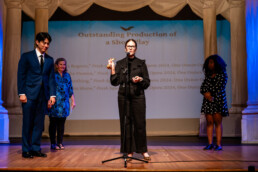
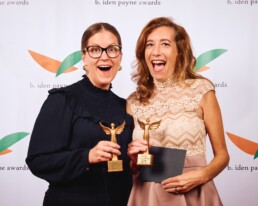
OOO Wins Two B. Iden Payne Awards!
What a night! 😍 Big hugs were shared!
On Monday, November 11, 2024, hundreds of folks gathered at the Scottish Rite Theater for a cathartic evening of celebrating the best of the performing arts in Austin: The 50th Annual B. Iden Payne Awards. Dancers, actors, singers, musicians, stage managers, tech and lighting folks, directors, producers, and craftspeople – it was like one giant cast party.
And OOO walked away with TWO awards!
Congrats to the team behind An Artist Regrets, winner of “Outstanding Production of a Short Play!”
(Cast members Kristin Bilodeau, Mikaela Pace, Maureen Broy Papovich, and Angela Irving; Director & Producer Julie Fiore, Music Director Joseph Choi, Tech Director Gus Sterneman, Assistant Director Carol Brown, Stage Manager Suzanne Smith, and House Manager Carlee Abschneider; along with creators Nell Clowder and Linda Nenno)
And congratulations to Maureen Broy Papovich on your much-deserved award, “Outstanding Performer in a Short Play!”
For the greater theatre community to embrace and include our medium of dynamic storytelling in this way is just 🫶🫶🫶 – we are incredibly grateful to be part of this community in Austin, and reinvigorated to do the important work that performing artists do.
This project has been funded in part by the Cultural Arts Division of the City of Austin Economic Development Department.
Searching for past performances, photos, or videos? Visit our Facebook, YouTube, and Instagram for archives of our work.

One Ounce Opera Earns Sixteen Nominations for 50th Annual B. Iden Payne Awards
This is so dreamy! A panel of our peers has nominated One Ounce Opera for SIXTEEN (16) B. Iden Payne Awards for the 2023-24 season! The 6th iteration of our Fresh Squeezed Ounce of Opera showcase racked up nods in several categories, including one – Outstanding Production of a Short Play – where all four of our micro-operas are individually recognized as the sole nominees.
Here are the nominations:
- Outstanding Music Direction: Joseph Choi, Fresh Squeezed Ounce of Opera
- Outstanding Original Score: Jens Ibsen, “Bubbie and the Demon,” Fresh Squeezed Ounce of Opera
- Outstanding Short Script (2):
- Nell Clowder and Linda Nenno, “An Artist’s Regrets,” Fresh Squeezed Ounce of Opera
- Cecilia Raker, “Bubbie and the Demon,” Fresh Squeezed Ounce of Opera
- Outstanding Performer in a Short Play (6)
- Jake Jacobsen (Politician), “What the Spirits Show,” Fresh Squeezed Ounce of Opera
- Cristina Jones (Older Sister), “I am worth nothing,” Fresh Squeezed Ounce of Opera
- Robert LeBas (Demon), “Bubbie and the Demon,” Fresh Squeezed Ounce of Opera
- Maureen Broy Papovich (40 Year Old), “An Artist’s Regrets,” Fresh Squeezed Ounce of Opera
- Maureen Broy Papovich (Karen), “Bubbie and the Demon,” Fresh Squeezed Ounce of Opera
- Cassidy Wallace (Bubbie), “Bubbie and the Demon,” Fresh Squeezed Ounce of Opera
- Outstanding Direction of a Short Play (2)
- Julie Fiore, “An Artist’s Regrets,” Fresh Squeezed Ounce of Opera
- Julie Fiore, “Bubbie and the Demon,” Fresh Squeezed Ounce of Opera
- Outstanding Production of a Short Play (4)
- “An Artist’s Regrets,” Fresh Squeezed Ounce of Opera
- “Bubbie and the Demon,” Fresh Squeezed Ounce of Opera
- “I am worth nothing,” Fresh Squeezed Ounce of Opera
- “What the Spirits Show,” Fresh Squeezed Ounce of Opera
To say we are thrilled would be an understatement. We’re looking forward to celebrating at the 50th Annual B. Iden Payne Awards Ceremony on Monday, November 11, 2024. Thank you to the council and the Austin theater community for this humbling recognition and inclusion of micro-operas in your nominations. It means so much to us.
And if you’re missing these stories and these folks, you can watch them anytime on our YouTube channel (don’t forget to subscribe!). Here’s a link to the whole FSOO 2024 playlist, including “what to expect” interviews with the cast.
[metaslider id=104684]

We're a 2024 Best Of Finalist!
Run, don’t walk, to the Austin Chronicle Best-Of Poll! It only takes a minute - but y’all - you could make a lasting, years-long impact.
Because there’s something so appropriate about One Ounce Opera being nominated as the Arts and Entertainment Wild Card. 🔥🎉👏 Something you already knew! So let’s make it official! ❤️
For the first time ever, you have the ability (the right! the power! the opportunity!) to vote for REIMAGINING OPERA IN UNEXPECTED SPACES.
You’ll enter your name, email, and then your vote. Only one ballot per person. You can adjust your online ballot at any time up until tonight, Monday, May 20, 2024 at 11:59pm.
(And while you’re there, slide over to “Politics and Media” and vote for KMFA Classical 89.5 as Best Radio Station!)
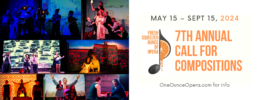
The 7th Annual Fresh Squeezed Ounce of Opera Composition Competition is now live!
THE PORTAL IS OPEN for 2024, to be performed in our 2024-25 season!
To see details and rules, and to apply now, click on the link below!
Creator Spotlight FSOO 2024: Jens Ibsen & Cecelia Raker
Get to know Composer Jens Ibsen & Librettist Cecelia Raker, creators of Bubbie and the Demon, which was originally commissioned by the prestigious American Opera Initiative at the Kennedy Center's Washington National Opera. This is its regional premiere.
Often the most poignant and powerful dialogue happens between those who create and those who perform. That’s why OOO connects our singing-artists with the composers and librettists selected for the 6th Annual Fresh Squeezed Ounce of Opera.
So if you’re curious about the musical themes, story inspiration, what to listen for, and more, you’re in the right place.
Here, enjoy insights about Bubbie and the Demon, written by Jens Ibsen & Cecelia Raker – with questions from the cast – sure to enhance your viewing experience.
First, a quick synopsis:
Bubbie has filled the void of Covid isolation by solving as many word searches and crosswords as possible…until her latest puzzle turns out to be a ƈʊʀֆɛɖ ֆʊʍʍօռɨռɢ ɨռƈǟռȶǟȶɨօռ that conjures a Demon from the netherworld. When Bubbie welcomes him with delight, insisting he must be her long-lost goth grandson, how far will her well-intentioned neighbor Karen go to convince the old woman that something is horribly wrong? A pandemic take on a viral internet myth, this short piece weaves together classical music and heavy metal to pose thorny questions about chosen family and what constitutes true evil.
Who or what were the biggest influences on the music for ‘Bubbie and the Demon’?
Jens: When I conceived of the piece, I had the idea of assigning each character their own music from a distinct genre and time period. Bubbie’s music is very inspired by Mahler and Korngold, and the Demon’s music was inspired by metal bands I love such as Tool, Sleep Token, and Zeal & Ardor. Karen’s music ended up becoming the sonic bridge between the chaos of the Demon and Bubbie’s serene romanticism—she embodies both polarities as she tries to keep it together as the perfect mother, but collapses into paroxysm during her aria and subsequent banishment from Bubbie’s home. Overall the work moves from an anachronistic sound into a more modern one, with the music of Bubbie’s opening aria being transformed by the finale into a rollicking, electric guitar-like dance.
Cecelia: Everything Jens said is really the answer here, of course. And a fun extra tidbit: the first time Jens and I talked was three weeks after I gave birth, so I was just beyond sleep deprived, to the point where I had no inhibitions left. He pitched me a bunch of normal, sophisticated story ideas, and then I was like, "You know, I've always kind of wanted to write a heavy-metal opera? And make it funny?" And I think that was the moment Jens and I really started to click as collaborators.
We've now reflected on the ways the pandemic actually brought people together for a while, despite their physical distance. What do you envision happens to Bubbie and her Demon going forward?
Jens: I like to think that the Demon becomes her companion for the rest of her earthly life. Maybe he accompanies her on grocery runs, maybe he’s a hulking figure at an eventual family reunion, maybe he picks up knitting. In my mind, the Demon has found his family in her and he’s going to see where that leads, what sort of person he can be. That truly is the heart of the piece—he is a demon because that is all he has been told he can be. Through Bubbie taking his humanity as a basic fact, he is granted the possibility to be human, at least in an emotional, metaphorical sense. To be loved is to be changed.
Cecelia: Jens and I have actually dreamed about expanding this piece into a full-length opera. Could happen two very different ways.
One is that we get to see more of the kind of moments Jens mentioned: the Demon must attend to some otherworldly duties, and Bubbie hires Karen's son Kyle to walk the Demon's Hellhound, the Demon learns to knit, etc.
But we've also talked about creating a series of linked short operatic stories, each based on different bizarre internet moments. BUBBIE is a takeoff on a Tumblr writing prompt that went viral a number of years back, starting a chain of fanfic versions, including ours. We're really interested in exploring the phenomenon of fanfic and what happens when you put anonymous, iterative, internet wish-fulfillment storytelling onstage. I mean, there's a lot of hilarious viral internet shit that deserves an opera, no? Perhaps the Demon's initial experiments in humanity include creating a bunch of those absolutely unhinged 5-Minute Crafts videos. What if Karen's moment of empowerment in this opera leads her to become one of these litigious Omegaverse romance novelists? The Demon uncovers the secret history of Bubbie's kids, and they turn out to be the kids in the Folger's incest commercial. Etc.So yeah, if you know anybody who wants to commission an Extremely Online Comedic Opera, please do let us know. (OOO notes: we totally do lol)
Karen seems to be a character who is trying to figure out who she is in the world. What do you think Karen should be trying to learn about herself that maybe TikTok is not providing her?
Jens: In my interpretation, Karen is someone who suffers from the perils of misogyny and motherhood, while also being someone of relative privilege. The way I imagine her, she has been raised to believe that if she is simply compassionate enough, if she gives enough of herself to a husband, to her children, to what other people want from her, then she will be rewarded for that compassion with a happy life, a simple life that need not be examined. But she feels the tension of that societal promise being a lie. At the same time, she’s a life-long people-pleaser. She wants to be good, socio-politically good, even, but has so little insight into the experiences of other people that her attempts at addressing her own “privilege and bias” seem comical. In essence, she is someone at the beginning of a journey towards understanding the struggles of marginalized people, as well as understanding the nature of her own struggles as a woman and mother. Her apotheosis as a character occurs in the argument scene with Bubbie and the Demon wherein she realizes her judgment of a situation (i.e., the Demon being big and scary) was correct. This is probably the first time in her life that her experience has been validated by anyone at all. I like to think this opens the door to her trusting herself as a person more and investigating the tension at the heart of her domestic life.
Cecelia: I really love Jens' answer here; it's spot-on. And also, the woman is entirely overwhelmed, because she's carrying a four-person one-dog household on her shoulders. She's probably unable to consume any content that requires more than like a two minute attention span. So to help her out, here are some places she might start:
- Read this comic about mental load and then check out Fair Play (yes, it's a book, but don't worry, they also have an Instagram). Your "feminist" husband needs to step it up!
- Check Your Privilege is a great place to start sitting with more nuance in conversations about bias.
- Scroll through Brit's gorgeous artwork and ponder confronting some of the trauma that comes from never feeling validated. Then go find a good therapist! It's chill! Therapy is great!
photo credits: for Jens – Matthew Washburn; for Cecelia – alison eden
Creator Spotlight FSOO 2024: Adrienne Inglis & Lisa Kay Adam
Get to know Composer Adrienne Inglis & Librettist/Poet Lisa Kay Adam, creators of I am worth nothing, which is based on a solo piece commissioned by Austin-based Inversion Ensemble.
Often the most poignant and powerful dialogue happens between those who create and those who perform. That’s why OOO connects our singing-artists with the composers and librettists selected for the 6th Annual Fresh Squeezed Ounce of Opera.
So if you’re curious about the musical themes, story inspiration, what to listen for, and more, you’re in the right place.
Here, enjoy insights about I am worth nothing, written by Adrienne Inglis & Lisa Kay Adam– with questions from the cast – sure to enhance your viewing experience.
First a quick synopsis:
I am worth nothing sets a stunning Coahuilteco/English poem by Texas poet Lisa Kay Adam. From the phrase Pīntci nakāmmam axām (I am worth nothing), Adam creates a vivid story of two young Coahuiltecan sisters and their encounters with newly arrived Spanish settlers and mission priests in the eighteenth century. Musically, the florid phrases and haunting modalities join with the sounds of drums and melancholic bells to paint a picture of exploitation, early death, and a lost way of life in the western Gulf coastal plains.
"I am worth nothing” tackles such a heavy and important subject matter. I’m curious if there was something about this specific text from Lisa Kay Adam’s book that drew you to set it to this piece.
Adrienne: I have a sister with whom I am very close. The heartbreaking death of the younger sister plus the tragic intersection of the Coahuilteco people, the mission priests, and the colonial Spaniards all drew me to Lisa’s remarkable poem. With my distant Ojibwe roots, the early eighteenth century setting in the western gulf coastal plains with a peoples whose language is now extinct also fascinated me. I should say that the poem does not explicitly say how the younger sister dies. It could easily have been disease, but her violent death is equally plausible, and arguably, more operatic. I also wanted to honor the vivid imagination and eloquence in which Lisa builds a historically informed and very powerful vignette out of a simple Coahuilteco phrase transcribed by a priest many generations ago.
Where do you see the older sister's character as she tells her story? Do you still see her involved in the church, or do you see her receiving messages of building up as opposed to tearing down?
Adrienne: The older sister strives to make sense of her changing world. She understands that she and her sister have assisted the rest of their distressed family by being traded to the Spaniard for blankets, horses, food, and more. This clear physical representation of their value made them feel helpful and worthy, even though they suffered in their new life with the Spaniard and his wife. When her sister dies, her life is again changed drastically at the cruel and violent hands of the Spaniard. Her world doesn’t make sense any more. When the priest rescues her from the Spaniard, she begins to understand her worth differently. She was not purchased by the priest, so no longer has monetary value. He taught her that not only is she worth nothing, but that she has the heavy burden of sin to carry—such a harsh authoritarian teaching. I like to think that she learns that her ability to work does not define her value, and that she is worthy no matter what. Only by God’s grace through prayer will she fly to heaven, weightless, forgiven, and freed from her sins.
Was there a particular reference point for the priest's music, or a particular vocal style you envisioned? Sounds a bit like Gregorian chant, but I'm curious if there are other influences in there as well.
Adrienne: Yes, liturgical chant absolutely influenced the priest’s part in the final section of the opera. The G minor pentatonic scale common to the Native American flute underpins the melodic material. The priest could choose to interpret the chant strictly as descended from Medieval European roots or showing some connection with the Coahuilteco people by infusing the melisma with typical Native American embellishments.