

FSOO 2025 Spotlight: Tyler Mabry
Meet the composer and librettist of Ray Bradbury, Age 12, at the Carnival in Waukegan, IL, one of the three winning micro-operas for FSOO 2025!
Often the most poignant and powerful dialogue happens between those who create and those who perform. That’s why OOO connects our singing-artists with the composers and librettists selected for the 7th Annual Fresh Squeezed Ounce of Opera.
If you’re curious about the story inspiration, what to listen for, what to expect, and more, you’re in the right place.
Here, get the scoop behind the story of Ray Bradbury, Age 12, at the Carnival in Waukegan, IL, written by Tyler Mabry – with questions from the cast – designed to enhance your experience. Bonus: you will be among the very first to hear this work, making its World Premiere!
First, a quick synopsis:
The true story, as (very) often told by beloved American author Ray Bradbury (Fahrenheit 451, Something Wicked This Way Comes, The Martian Chronicles), of the mysterious, fantastical Dill Brothers Circus that sparked his interest in becoming a writer. A cascading carousel of wonder!
What led you to uncover this specific anecdote from Ray Bradbury’s life? Is this experience, which influenced him both personally and as a writer, something that has resonated with you for a long time, or was it a recent discovery that sparked the creation of this work?
Tyler: I have admired Bradbury’s work since I was a 12 year old boy myself, but I only recently learned about his boyhood encounter with Mr. Electrico. The story immediately resonated with me, for personal as well as literary reasons. When I came to Austin in the 90s, I was fairly young and sheltered, but I was fortunate to have encounters and friendships with people who — like Mr. Electrico — introduced me to the city’s musical and theatrical scenes. Coming from a rural and conservative background, as I did, I met many people who at first seemed very strange to me, like they were from a different universe! But it was an incredible universe, and I knew that I wanted to belong to it. Those connections absolutely transformed my life.
What was it about this story that led you to adapt it into an opera?
If there was one detail that solidified my decision to make this into an opera, it was the moment when Mr. Electrico stands with young Ray by the lake to tell him “you were my best friend in France, and you died in my arms in the battle of the Ardennes Forest.” When I saw that, I thought to myself, “now THAT is an aria!” I love opera subjects that are larger than life, and I’ve always been attracted to dramatic works based on real events. So this story seemed like a natural fit.
How important was it for the music to evoke a sense of nostalgia, considering Ray reflects on this experience in the opera? Did you incorporate any musical references to the time and place in which the story is set?
In the opening passages, when “adult Ray” begins the story, there is certainly a nostalgic sensibility. Specifically, when he sings “I have told the story many times, always in wonder,” there is a very dreamy and sentimental sequence in the accompaniment. And at the end of the opera, when adult Ray reappears to take the stage with his memories, it becomes nostalgic again, this time spiked with contemplative mystery. But in between, I was not particularly thinking of the events as nostalgic, because they are happening to young Ray in real time! As far as musical references go, the most explicit reference is certainly “Beautiful Ohio” – I’ll talk more about that in an answer to Nicholas’s question down below.
Between a fantastical Mr. Electrico, who embodies power and immortality, but is brought back to a time of vulnerability, and young Ray who is confronted with themes of death, life, and immortality, you have a range of complex characters to convey in such a short period of time. How did you navigate these contrasts?
I love this question! Character contrasts are the heart of the piece; in many ways, the opera is constructed around juxtapositions. You can communicate a great deal about characters through the music itself. “Come Away,” which introduces the carnival performers, is showy and energetic and a little unstable — we see a performative, imposing side of Mr. Electrico, with his promises of immortality. Then young Ray comes bursting in with a very eager, frantic, and almost naïve melody. Later on, as Mr. Electrico reveals his beliefs about Ray’s past life, there is some polytonality to suggest an uneasy overlapping of the past and present. As you say, it is a very short opera, and so these contrasts and these interrelationships have to be established quickly. But the emotional core of this opera is the wonder and mystery of our impact on one another’s lives. By the time we arrive at the final trio, and Adult Ray, Young Ray, and Mr. Electrico sing “Live forever!,” my hope is that this phrase, (which was originally pronounced in the middle of a carnival act!) has grown in weight and poignancy. In some strange but meaningful way, Ray has accepted Mr. Electrico’s promise of immortality.
To what degree did the setting influence the score? How did you infuse the carnival into the music?
I love circus and circus-adjacent music, from traditional circus repertoire to Nino Rota to dark cabaret! The most noticeably circus-influenced music in the show is in the song “Come Away,” which establishes the carnival scene – it has a kind of lopsided oom-pah rhythm, with a bass ostinato alternating between 6/8 and 5/8, which gives it a rhythm that is driving and stylistically familiar but also off-kilter and destabilizing. And the opera ends in front of the carousel, so the setting for the final song is certainly influenced by the steady, slightly woozy rhythm of the carousel.
One of the inspiration articles you shared with us mentioned that Ray’s uncle had just passed prior to him going to the carnival. From your perspective, if Ray hadn’t just had that brush with death would the carnival still have had the same impact on him? And if not, how would his journey as an author have been altered?
I have thought about this a lot, actually! I think that Ray was grappling with two kinds of death simultaneously – the “death of the spirit,” represented by his rejection of his own creative and imaginative life in order to conform with his peers, and also, as you mention, the death of his uncle. In the current libretto, I have given more explicit focus to the former. But the latter is very important as well! In one telling of the story, RB says that he was in the car, on the way to his uncle’s wake, when he got out and began running, returning to the carnival so that he could see Mr. Electrico again. “I was running away from death wasn’t I? I was running toward life.” If I ever work this micro-opera into a longer-form piece, the plot would probably involve Ray visiting the carnival twice, with the funeral and the family mourning happening in between those two visits.
Of course we can’t ever know what Bradbury’s journey would have been like if these events hadn’t happened, but it seems that his encounter with Mr. Electrico, and with the circus atmosphere itself, was truly transformative. After young Ray went home, he began writing almost immediately, and he kept writing for the rest of his life.
The story takes place in Illinois, but the ending song is called “Beautiful Ohio.” Why was that song chosen? Did Ray Bradbury recall hearing it at the carnival?
I’m glad that you asked this! As you guessed, “Beautiful Ohio” is precisely the song that Ray Bradbury remembered hearing as he left the carnival. In his own words: “…when I left the carnival that day I stood by the carousel and I watched the horses running around and around to the music of ‘Beautiful Ohio’ and I cried.” Having said that, I certainly didn’t choose to end the opera this way only for the sake of historical accuracy. I was not actually familiar with the song, but when I looked up the words (which Bradbury never mentions) I felt that it was powerfully resonant with the themes I was trying to highlight in the story.
“Love had its start / then in my heart / and like a flower grew” – this is an apt description of what happened to Ray that day: the planting of something that will take root and grow! And then there is this phrase: “in dreams again I see visions of what used to be.”
Anyone familiar with the tune will notice that I’ve re-harmonized “Beautiful Ohio” fairly radically. Hopefully, the new harmonization imparts a haunting circus vibe to the beginning, and also adds emotional poignancy to the ending.
It seemed like the right ending to me! But on some level, I do wonder if people will leave thinking “Ohio? I thought it was Illinois!”
Watch One Ounce Opera’s live recording of Ray Bradbury…!
Get the scoop from the cast – watch the video below!
This project has been funded in part by the Cultural Arts Division of the City of Austin Economic Development Department.
Searching for past performances, photos, or videos? Visit our Facebook, YouTube, and Instagram for archives of our work.

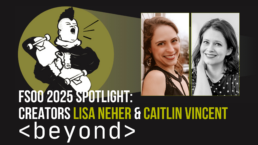
FSOO 2025 Spotlight: Lisa Neher and Caitlin Vincent
Meet the composer and librettist of Beyond, one of the three winning micro-operas for FSOO 2025!
Often the most poignant and powerful dialogue happens between those who create and those who perform. That’s why OOO connects our singing-artists with the composers and librettists selected for the 7th Annual Fresh Squeezed Ounce of Opera.
If you’re curious about the story inspiration, what to listen for, what to expect, and more, you’re in the right place.
Here, get the scoop behind the story of Beyond, written by Lisa Neher (composer) & Caitlin Vincent (librettist) – with questions from the cast – designed to enhance your experience. Bonus: you will be among the very first to hear this work, making its World Premiere!
First, a quick synopsis:
Consider what waits for you beyond that door. A glimpse of one possible future for humanity in the stars, this short work is a compelling meditation on life, death, the cycle of oppression, and what it means to be truly human.
What was the initial germ of an idea that evolved into this opera?
Lisa: I’m a big science fiction fan and it’s a genre I would love to see more in opera and classical music. Sci-Fi is a fabulous genre for asking questions, or telling new stories that aren’t stuck in old gender and identity tropes, and for expanding the opera canon of characters for all voices, especially for sopranos and mezzos, who are underused in standard repertoire. There are so many developments happening right now with “artificial intelligence” / large language models and technology used in our daily lives that it felt relevant to extrapolate that into a future society that relies on androids as its working class laborers. We were both interested in how a story about androids and their sentience and self-determination could reflect many topics we care about, from workers rights to the rights of undocumented people to our relationship to technology.
Caitlin: Lisa and I are both big science fiction fans and we were really intrigued by the possibilities for bridging sci-fi and opera. This particular idea evolved in response to a 2022 call for proposals for a “micro-opera” for two female voices. Lisa suggested that we explore something futuristic involving space travel, and I used the germ of that idea to develop a storyline about two androids waiting to be decommissioned.
Did the libretto come first or did they evolve at the same time?
Caitlin: In all of my collaborations, I always write the libretto first. This gives me an opportunity to map out the structure and pacing of the opera’s story and also incorporate the nuances of each character into the text. After I finalized a draft of the libretto for Beyond, I handed it off to Lisa so she could start developing the musical language. Throughout the process of composition, we remained in close contact and worked through a number of additional changes and rewrites in the process of her setting the text to music.
Lisa: Caitlin wrote the libretto first before I composed the music. For a short opera, I find it particularly important that the libretto is written and workshopped first, because it will inspire and dictate the form and pacing of the piece. Seeing the entire story helps me to structure the length of arias and duets, pacing of exposition versus action musically, and to create motives that express the characters and can evolve with them as they change during the story.
What caused humans to leave earth?
Lisa: One of the things I appreciate about Caitlin’s libretto is that it leaves us with so many more questions than answers! My sense as we were working on the piece was that the Earth has become unlivable due to climate change and pollution, or overpopulated to the point where a group of humans needed to find a different location to thrive.
Caitlin: As I was writing this text, I imagined humans being forced to leave earth because of a climate change disaster. However, as Lisa suggests, it really could be any kind of apocalyptic event! The key is that humans were forced to go…it wasn’t an intentional choice. And in their desperation to ensure the survival of the human race, they made decisions that gradually stripped away their humanity, including building what essentially amounts to a slave population.
Why did they keep building androids after figuring out they were sentient and would need to be destroyed?
Caitlin: Because of the length of the journey and the technological complexities of maintaining a space fleet, the humans need the androids to survive. However, as soon as they realized the androids had grown sentient, they did begin to “clean house”: culling the majority of the older generations and replacing them with younger models that hadn’t yet reached sentience. This is one of the reasons for 142-6’s bitterness: they’re one of the few surviving androids from those early generations. What has changed—and what we’re capturing in Beyond—is that humans are now finally approaching their destination and have decided to dismantle the entire android population before landing on the site of their new colony.
Lisa: Space travel to any potentially habitable world would take many years, so my sense is that the trip is quite long and humans on the voyage needed workers that weren’t human. Perhaps humans are in deep hibernation or something of that sort, due to the far distance of the new colony. So there is a need for labor until they get to the colony–but as we discover, the timeline has been moved up, so the humans must be close to where they are going to settle and want to “clean up” any loose threads.
We know how 142-6 and 503-2 find each other. How did you find each other (Lisa and Caitlin)?
Lisa: I’ve been aware of Caitlin’s work for a while now. We were introduced by composer Tom Cipullo, who was my mentor in the National Association of Teachers of Singing Composer Mentorship program a few years ago. Since then, we’ve written a song cycle about climate change, “Honeyed Voices,” commissioned by Cristina Gallo for her Siren Songs project, and a choral work, “I dug up a rose”, commissioned by Porter-Gaud School in honor of 50 years of the school being a co-educational institution. It’s so wonderful to work with Caitlin because she has a specific theatrical vision for her words and she writes in such a character-driven way. I come from a background in theatre, and that gives us a common frame of reference for storytelling through opera and beyond.
Caitlin: Lisa and I have a number of mutual connections, and I’ve been a long-time admirer of her work. We had our first official “meet and greet “ via Zoom back in 2022 and have since collaborated on three pieces together!
Watch One Ounce Opera’s live recording of Beyond:
Go beyond about Beyond! Get the scoop (and possible spoilers?) in this short vid below!
This project has been funded in part by the Cultural Arts Division of the City of Austin Economic Development Department.
Searching for past performances, photos, or videos? Visit our Facebook, YouTube, and Instagram for archives of our work.

7th Annual FSOO
Immerse yourself in dynamic storytelling


Experience Austin’s annual micro-opera showcase – one of the most anticipated and award-winning indie-classical events of the season!
One Ounce Opera reviewed over 50 works submitted from all over the world to line up an engaging program of three (3) new micro-operas that will transport you with the sonic tellings of connective, transformative, oh-so-human stories.
Short stories that feel NOW. Dynamic. Familiar, yet…not.
And we welcome you to experience all three winning micro-operas in a single 70-minute program: The 7th Fresh Squeezed Ounce of Opera [FSOO]!
Who is FSOO for? EVERYONE. Here’s a great place to jump in:
In-person audience information, in case you’re curious:
Hey, curious arts lover! Overall, what should you expect at FSOO? A super low-lift evening! Our annual showcase is a great escape, regardless of your previous experiences with opera. Three brand new, dynamic works sung in ~20 minutes each, in English (with a little bit of Spanish!), performed by fellow Austinites in an intimate, immersive, warm, welcoming, and unexpected space. General admission seating means you choose your own adventure. And a complimentary bar, featuring Live Oak Brewing and other tasty bevs, rounds out your experience.
Only 80 available seats per show, so act fast. Recommended for ages 8 and up.
FSOO is presented at our showcase home, DADALAB (2008 Alexander Ave, 78722)! Tickets are available by suggested donation. We highly recommend getting a seat online because we often sell out; however, any remaining seats will be sold at the door.

Las Auténticas
music by Benjamin Morris
libretto by Laura Fuentes
“The Most Authentic Taco in LA,” eh? Join Jenny and her Tía Luz the moment they hear from the “Lord of Tortillas” himself – Esteban Eats – and prepare their food truck for a day they’ll not soon forget. ¿Porqué no hacemos unos tacos?
Luz – Sandra Mercado
Jenny – Annisha Mackenzie
Esteban/Gary – Julius Young
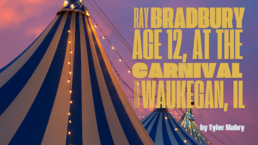
Ray Bradbury, Age 12, at the Carnival in Waukegan, Illinois
music & libretto by Tyler Mabry
The true story, as (very) often told by beloved American author Ray Bradbury (Fahrenheit 451, Something Wicked This Way Comes, The Martian Chronicles), of the mysterious, fantastical Dill Brothers Circus that sparked his interest in becoming a writer. A cascading carousel of wonder!
Ray Bradbury – Nicholas Flott
Mr. Electrico – Jake Jacobsen
Young Ray – Hillary Schranze
Zara/Tattooed Man – Kaley Williams
Calista/Others – Sandra Villwock

Beyond
music by Lisa Neher
libretto by Caitlin Vincent
Consider what waits for you beyond that door. A glimpse of one possible future for humanity in the stars, this short work is a compelling meditation on life, death, the cycle of oppression, and what it means to be truly human.
142-6 – Patricia Combs
503-2 – Andréa Ochoa
Stage Director & Producer: Julie Fiore
Music Director & Pianist: Joseph Choi
Technical + Lighting Director: Matt Smith
Assistant Director: Carol Brown
Stage Manager: Monica Kurtz
KMFA Classical 89.5 – Media Sponsor

Live Oak Brewing – Beer Sponsor
This project has been funded in part by the Cultural Arts Division of the City of Austin Economic Development Department.