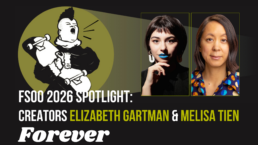
Meet the composer and librettist of Forever, one of the three winning micro-operas for FSOO 2026!
Often the most poignant and powerful dialogue happens between those who create and those who perform. That’s why OOO connects our singing-artists with the composers and librettists selected for the 8th Fresh Squeezed Ounce of Opera.
If you’re curious about the story inspiration, what to listen for, what to expect, and more, you’re in the right place.
Here, get the scoop behind the story of Forever by Elizabeth Gartman (composer) and Melisa Tien (librettist) – with questions from the cast – designed to enhance your experience.
First, a quick synopsis:
Eons after humans have gone extinct, a strange, chemically supercharged world remains. Perhaps all a survivor can do is try and navigate their surroundings, one toxic blast at a time. As the environmental legacy of the human species gets heftier, allow a pair of musically inclined polyfluoroalkyl substances and a hardy microorganism to paint a picture of a possible future Earth. Forever is a tragicomic opera about figuring out one’s place on a changing planet.
Commissioned through the American Opera Initiative at Washington National Opera
How is the man-made/non-human nature of (characters) The Wrapper and The Wristband – when compared to the organic nature of the Tardigrade – demonstrated by the way you wrote the textual cadences and the musical structures in this work? And do these things change over the course of their story arcs?
Melisa: When I was thinking about how to represent the microplastics in the libretto, I figured I’d try and make them seem as human as possible—that is, with characteristics like shyness or self-consciousness—since they were created by humans. I aimed for speech mannerisms that communicated ‘needy and cute’ because I imagined if extraterrestrial beings were to observe humans, that’s how they might sum us up. Subsequently it seemed like a good idea to give the tardigrade a superhuman aura, with a heightened manner of speaking befitting a benevolent, mischievous deity. We meet the tardigrade as they’re singing a beautiful aria that borders on a lamentation. They’re singing about the natural world they came from, which no longer exists as it once did, but which they still find beauty in. The text is more lyrical here than anywhere else in the opera, and is a direct through-line to my personal feelings about our natural environment.
Elizabeth: The non-organic characters Wrapper and Wristwatch are musically represented as “otherworldly” through constantly changing meters, extended vocal techniques, large leaps, and registrally expansive orchestrations. In contrast, the organic Tardigrade is introduced with stagnant meter and significant consonance. While the Wristwatch doesn’t really change from start to finish – his intentions as a character don’t quite evolve as significantly – the Wrapper becomes more confident both in herself and as to how she’d like to spend the remainder of her days decomposing. She leads the trio more by the end, and soars above vocally.
In a world with so much plastic usage and companies utilizing these products, what brought you to choose the origins of the two plastic characters?
Elizabeth: When Melisa and I were initially given the prompt to propose three pitches for a story, one of those three, we decided, would be a “story centered on non-human characters.” Melisa suggested the characters be ones who outlast the human lifespan. Through research, forever chemicals were brought up and decided upon. Melisa brought both humor and science in crafting the characters from there.
Melisa: I came up with the personalities of each character first, with the intention of having them be funny, relatable, and on opposite ends of the status spectrum. Once I figured out what kind of personalities they had, I thought about the kind of plastic product they would have come from that would seemingly go hand-in-hand with their respective personas. The suave-on-the-outside-yet-insecure on-the-inside character felt like it could possibly originate from a high-end smartwatch. In contrast, the shy-at-first-then-highly-confident character seemed like it might originate in a product associated with low status yet was something everyone partakes in. I thought of fast food products, which led me to fast food wrappers. All that was left was to find the humor in their origins’ brand names.
What is the inspiration behind the directive for the singers to use a vocal fry sound? And the Michael Jackson/”The Girl is Mine” reference – what is it about that vibe that speaks to you for this piece?
Elizabeth: The vocal fry, to me, represents the “life” leaving the characters following the chaotic, sped-up glimpse at their previous lives. It is the last bit of their existence before they have decomposed so much that they are not recognizable as their previous forms anymore. Darkly, this mirrors the image and sound of life leaving the human population on the brink of apocalypse. When Melisa added the MJ quote into the libretto; I interpreted it as the Tardigrade referencing an “ancient musical relic,” relating their distant connection to the humans who lived many years ago.
Melisa: As I recall, I really wanted the tardigrade to do something goofy yet graceful onstage, particularly while the Wristband and Wrapper were arguing over what, exactly, the tardigrade was. I suggested a moonwalk in the stage directions, which led to an actual MJ reference in the text, which then made me wonder if things were getting too specific. In the end, we kept these in, because it seemed just strange and incongruous enough to cause head-scratching and be funny at the same time—which is how tardigrades are often viewed, and come to think of it, how MJ was often viewed.
This project is supported in part by an Elevate Grant of Austin Arts, Culture, Music and Entertainment.
Searching for past performances, photos, or videos? Visit our Facebook, YouTube, and Instagram for archives of our work.