Meet the composer and librettist of Having Guests for Dinner, one of the three winning micro-operas for FSOO 2026!
Often the most poignant and powerful dialogue happens between those who create and those who perform. That’s why OOO connects our singing-artists with the composers and librettists selected for the 8th Fresh Squeezed Ounce of Opera.
If you’re curious about the story inspiration, what to listen for, what to expect, and more, you’re in the right place.
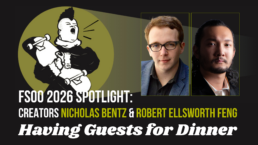
Here, get the scoop behind the story of Having Guests for Dinner by Nicholas Bentz (composer) and Robert Ellsworth Feng (librettist) – with questions from the cast – designed to enhance your experience.
First, a quick synopsis:
When Marcus and Laura attend a “dinner for three” hosted by the refined but eccentric Christoph Aberfield, things take a turn for the macabre. Between courses and questionable puns, the two become increasingly suspicious of their host. Will the two catch Christoph red-handed, or will they meat their demise? The steaks have never been higher…
Horror and comedy both depend heavily on timing and tension. How did opera as a medium influence the way you built those moments of suspense and comic release?
Robert: For me, opera is entirely built on timing and tension. People often say that music is how we decorate with time, and opera is that but with extreme precision. In that way, I feel the genres of horror/comedy and opera helped each other out in winding up a punchline or driving up tension (horror films have done this particularly well with their scores).
What was your inspiration in creating the particular sound world of this piece? Any specific musical influences?
Nicholas: When I was writing the music for Having Guests for Dinner, I was going through a particular phase of listening deeply to the music of early cartoons. I had the music of composers like Carl Stallings and Scott Bradley on repeat as I studied their sense of timing and how they used music to convey humor. I think humor and irony are some of the hardest things to get across in music, so it was important to look to models of pieces that really authentically engage in slapstick and comedy.
In working through your work, we’ve noticed tempos that ebb and flow depending on which character has the floor. How do you see tempo playing a role in how your characters were created?
Nicholas: Tempo is really integral to character for me, but I would go a step outward and say that the important facet for me is pacing. The speed in which someone says a line can sometimes say more than the line itself, and when these two things are at odds it can lead to an exciting sense of tension that can propel a narrative forward. The way that time is handled conveys who’s ‘in charge’ of the scene, who’s reacting to who, and shifts in time can accentuate power exchanges between characters. Like Robert said earlier, opera is so much about timing and tension, and how we ratchet it up and let it deflate (or explode!).
This project is supported in part by an Elevate Grant of Austin Arts, Culture, Music and Entertainment.
Searching for past performances, photos, or videos? Visit our Facebook, YouTube, and Instagram for archives of our work.