

FSOO 2025 Spotlight: Tyler Mabry
Meet the composer and librettist of Ray Bradbury, Age 12, at the Carnival in Waukegan, IL, one of the three winning micro-operas for FSOO 2025!
Often the most poignant and powerful dialogue happens between those who create and those who perform. That’s why OOO connects our singing-artists with the composers and librettists selected for the 7th Annual Fresh Squeezed Ounce of Opera.
If you’re curious about the story inspiration, what to listen for, what to expect, and more, you’re in the right place.
Here, get the scoop behind the story of Ray Bradbury, Age 12, at the Carnival in Waukegan, IL, written by Tyler Mabry – with questions from the cast – designed to enhance your experience. Bonus: you will be among the very first to hear this work, making its World Premiere!
First, a quick synopsis:
The true story, as (very) often told by beloved American author Ray Bradbury (Fahrenheit 451, Something Wicked This Way Comes, The Martian Chronicles), of the mysterious, fantastical Dill Brothers Circus that sparked his interest in becoming a writer. A cascading carousel of wonder!
What led you to uncover this specific anecdote from Ray Bradbury’s life? Is this experience, which influenced him both personally and as a writer, something that has resonated with you for a long time, or was it a recent discovery that sparked the creation of this work?
Tyler: I have admired Bradbury’s work since I was a 12 year old boy myself, but I only recently learned about his boyhood encounter with Mr. Electrico. The story immediately resonated with me, for personal as well as literary reasons. When I came to Austin in the 90s, I was fairly young and sheltered, but I was fortunate to have encounters and friendships with people who — like Mr. Electrico — introduced me to the city’s musical and theatrical scenes. Coming from a rural and conservative background, as I did, I met many people who at first seemed very strange to me, like they were from a different universe! But it was an incredible universe, and I knew that I wanted to belong to it. Those connections absolutely transformed my life.
What was it about this story that led you to adapt it into an opera?
If there was one detail that solidified my decision to make this into an opera, it was the moment when Mr. Electrico stands with young Ray by the lake to tell him “you were my best friend in France, and you died in my arms in the battle of the Ardennes Forest.” When I saw that, I thought to myself, “now THAT is an aria!” I love opera subjects that are larger than life, and I’ve always been attracted to dramatic works based on real events. So this story seemed like a natural fit.
How important was it for the music to evoke a sense of nostalgia, considering Ray reflects on this experience in the opera? Did you incorporate any musical references to the time and place in which the story is set?
In the opening passages, when “adult Ray” begins the story, there is certainly a nostalgic sensibility. Specifically, when he sings “I have told the story many times, always in wonder,” there is a very dreamy and sentimental sequence in the accompaniment. And at the end of the opera, when adult Ray reappears to take the stage with his memories, it becomes nostalgic again, this time spiked with contemplative mystery. But in between, I was not particularly thinking of the events as nostalgic, because they are happening to young Ray in real time! As far as musical references go, the most explicit reference is certainly “Beautiful Ohio” – I’ll talk more about that in an answer to Nicholas’s question down below.
Between a fantastical Mr. Electrico, who embodies power and immortality, but is brought back to a time of vulnerability, and young Ray who is confronted with themes of death, life, and immortality, you have a range of complex characters to convey in such a short period of time. How did you navigate these contrasts?
I love this question! Character contrasts are the heart of the piece; in many ways, the opera is constructed around juxtapositions. You can communicate a great deal about characters through the music itself. “Come Away,” which introduces the carnival performers, is showy and energetic and a little unstable — we see a performative, imposing side of Mr. Electrico, with his promises of immortality. Then young Ray comes bursting in with a very eager, frantic, and almost naïve melody. Later on, as Mr. Electrico reveals his beliefs about Ray’s past life, there is some polytonality to suggest an uneasy overlapping of the past and present. As you say, it is a very short opera, and so these contrasts and these interrelationships have to be established quickly. But the emotional core of this opera is the wonder and mystery of our impact on one another’s lives. By the time we arrive at the final trio, and Adult Ray, Young Ray, and Mr. Electrico sing “Live forever!,” my hope is that this phrase, (which was originally pronounced in the middle of a carnival act!) has grown in weight and poignancy. In some strange but meaningful way, Ray has accepted Mr. Electrico’s promise of immortality.
To what degree did the setting influence the score? How did you infuse the carnival into the music?
I love circus and circus-adjacent music, from traditional circus repertoire to Nino Rota to dark cabaret! The most noticeably circus-influenced music in the show is in the song “Come Away,” which establishes the carnival scene – it has a kind of lopsided oom-pah rhythm, with a bass ostinato alternating between 6/8 and 5/8, which gives it a rhythm that is driving and stylistically familiar but also off-kilter and destabilizing. And the opera ends in front of the carousel, so the setting for the final song is certainly influenced by the steady, slightly woozy rhythm of the carousel.
One of the inspiration articles you shared with us mentioned that Ray’s uncle had just passed prior to him going to the carnival. From your perspective, if Ray hadn’t just had that brush with death would the carnival still have had the same impact on him? And if not, how would his journey as an author have been altered?
I have thought about this a lot, actually! I think that Ray was grappling with two kinds of death simultaneously – the “death of the spirit,” represented by his rejection of his own creative and imaginative life in order to conform with his peers, and also, as you mention, the death of his uncle. In the current libretto, I have given more explicit focus to the former. But the latter is very important as well! In one telling of the story, RB says that he was in the car, on the way to his uncle’s wake, when he got out and began running, returning to the carnival so that he could see Mr. Electrico again. “I was running away from death wasn’t I? I was running toward life.” If I ever work this micro-opera into a longer-form piece, the plot would probably involve Ray visiting the carnival twice, with the funeral and the family mourning happening in between those two visits.
Of course we can’t ever know what Bradbury’s journey would have been like if these events hadn’t happened, but it seems that his encounter with Mr. Electrico, and with the circus atmosphere itself, was truly transformative. After young Ray went home, he began writing almost immediately, and he kept writing for the rest of his life.
The story takes place in Illinois, but the ending song is called “Beautiful Ohio.” Why was that song chosen? Did Ray Bradbury recall hearing it at the carnival?
I’m glad that you asked this! As you guessed, “Beautiful Ohio” is precisely the song that Ray Bradbury remembered hearing as he left the carnival. In his own words: “…when I left the carnival that day I stood by the carousel and I watched the horses running around and around to the music of ‘Beautiful Ohio’ and I cried.” Having said that, I certainly didn’t choose to end the opera this way only for the sake of historical accuracy. I was not actually familiar with the song, but when I looked up the words (which Bradbury never mentions) I felt that it was powerfully resonant with the themes I was trying to highlight in the story.
“Love had its start / then in my heart / and like a flower grew” – this is an apt description of what happened to Ray that day: the planting of something that will take root and grow! And then there is this phrase: “in dreams again I see visions of what used to be.”
Anyone familiar with the tune will notice that I’ve re-harmonized “Beautiful Ohio” fairly radically. Hopefully, the new harmonization imparts a haunting circus vibe to the beginning, and also adds emotional poignancy to the ending.
It seemed like the right ending to me! But on some level, I do wonder if people will leave thinking “Ohio? I thought it was Illinois!”
Watch One Ounce Opera’s live recording of Ray Bradbury…!
Get the scoop from the cast – watch the video below!
This project has been funded in part by the Cultural Arts Division of the City of Austin Economic Development Department.
Searching for past performances, photos, or videos? Visit our Facebook, YouTube, and Instagram for archives of our work.

FSOO 2025 Spotlight: Lisa Neher and Caitlin Vincent
Meet the composer and librettist of Beyond, one of the three winning micro-operas for FSOO 2025!
Often the most poignant and powerful dialogue happens between those who create and those who perform. That’s why OOO connects our singing-artists with the composers and librettists selected for the 7th Annual Fresh Squeezed Ounce of Opera.
If you’re curious about the story inspiration, what to listen for, what to expect, and more, you’re in the right place.
Here, get the scoop behind the story of Beyond, written by Lisa Neher (composer) & Caitlin Vincent (librettist) – with questions from the cast – designed to enhance your experience. Bonus: you will be among the very first to hear this work, making its World Premiere!
First, a quick synopsis:
Consider what waits for you beyond that door. A glimpse of one possible future for humanity in the stars, this short work is a compelling meditation on life, death, the cycle of oppression, and what it means to be truly human.
What was the initial germ of an idea that evolved into this opera?
Lisa: I’m a big science fiction fan and it’s a genre I would love to see more in opera and classical music. Sci-Fi is a fabulous genre for asking questions, or telling new stories that aren’t stuck in old gender and identity tropes, and for expanding the opera canon of characters for all voices, especially for sopranos and mezzos, who are underused in standard repertoire. There are so many developments happening right now with “artificial intelligence” / large language models and technology used in our daily lives that it felt relevant to extrapolate that into a future society that relies on androids as its working class laborers. We were both interested in how a story about androids and their sentience and self-determination could reflect many topics we care about, from workers rights to the rights of undocumented people to our relationship to technology.
Caitlin: Lisa and I are both big science fiction fans and we were really intrigued by the possibilities for bridging sci-fi and opera. This particular idea evolved in response to a 2022 call for proposals for a “micro-opera” for two female voices. Lisa suggested that we explore something futuristic involving space travel, and I used the germ of that idea to develop a storyline about two androids waiting to be decommissioned.
Did the libretto come first or did they evolve at the same time?
Caitlin: In all of my collaborations, I always write the libretto first. This gives me an opportunity to map out the structure and pacing of the opera’s story and also incorporate the nuances of each character into the text. After I finalized a draft of the libretto for Beyond, I handed it off to Lisa so she could start developing the musical language. Throughout the process of composition, we remained in close contact and worked through a number of additional changes and rewrites in the process of her setting the text to music.
Lisa: Caitlin wrote the libretto first before I composed the music. For a short opera, I find it particularly important that the libretto is written and workshopped first, because it will inspire and dictate the form and pacing of the piece. Seeing the entire story helps me to structure the length of arias and duets, pacing of exposition versus action musically, and to create motives that express the characters and can evolve with them as they change during the story.
What caused humans to leave earth?
Lisa: One of the things I appreciate about Caitlin’s libretto is that it leaves us with so many more questions than answers! My sense as we were working on the piece was that the Earth has become unlivable due to climate change and pollution, or overpopulated to the point where a group of humans needed to find a different location to thrive.
Caitlin: As I was writing this text, I imagined humans being forced to leave earth because of a climate change disaster. However, as Lisa suggests, it really could be any kind of apocalyptic event! The key is that humans were forced to go…it wasn’t an intentional choice. And in their desperation to ensure the survival of the human race, they made decisions that gradually stripped away their humanity, including building what essentially amounts to a slave population.
Why did they keep building androids after figuring out they were sentient and would need to be destroyed?
Caitlin: Because of the length of the journey and the technological complexities of maintaining a space fleet, the humans need the androids to survive. However, as soon as they realized the androids had grown sentient, they did begin to “clean house”: culling the majority of the older generations and replacing them with younger models that hadn’t yet reached sentience. This is one of the reasons for 142-6’s bitterness: they’re one of the few surviving androids from those early generations. What has changed—and what we’re capturing in Beyond—is that humans are now finally approaching their destination and have decided to dismantle the entire android population before landing on the site of their new colony.
Lisa: Space travel to any potentially habitable world would take many years, so my sense is that the trip is quite long and humans on the voyage needed workers that weren’t human. Perhaps humans are in deep hibernation or something of that sort, due to the far distance of the new colony. So there is a need for labor until they get to the colony–but as we discover, the timeline has been moved up, so the humans must be close to where they are going to settle and want to “clean up” any loose threads.
We know how 142-6 and 503-2 find each other. How did you find each other (Lisa and Caitlin)?
Lisa: I’ve been aware of Caitlin’s work for a while now. We were introduced by composer Tom Cipullo, who was my mentor in the National Association of Teachers of Singing Composer Mentorship program a few years ago. Since then, we’ve written a song cycle about climate change, “Honeyed Voices,” commissioned by Cristina Gallo for her Siren Songs project, and a choral work, “I dug up a rose”, commissioned by Porter-Gaud School in honor of 50 years of the school being a co-educational institution. It’s so wonderful to work with Caitlin because she has a specific theatrical vision for her words and she writes in such a character-driven way. I come from a background in theatre, and that gives us a common frame of reference for storytelling through opera and beyond.
Caitlin: Lisa and I have a number of mutual connections, and I’ve been a long-time admirer of her work. We had our first official “meet and greet “ via Zoom back in 2022 and have since collaborated on three pieces together!
Watch One Ounce Opera’s live recording of Beyond:
Go beyond about Beyond! Get the scoop (and possible spoilers?) in this short vid below!
This project has been funded in part by the Cultural Arts Division of the City of Austin Economic Development Department.
Searching for past performances, photos, or videos? Visit our Facebook, YouTube, and Instagram for archives of our work.

OOO makes the list 3x – KMFA's Top 12 of 2024
Breaking news! OOO Makes the List 3x!
Capping off a banner year, another sweet surprise!
One Ounce was a featured part of three productions mentioned in KMFA Classical 89.5’s Top 12 Classical Highlights of 2024. In chronological order, here’s where we made the list (and links if you’d like to relive any of these moments):
- 6th Annual Fresh Squeezed Ounce of Opera, our flagship micro-opera showcase from February & March of 2024
- 2nd Annual Here Be Monsters Festival, a weekend-long celebration of the Austin indie-classical community
- 2024 Opera Austin Festival, a community-building event featuring new opera producers in Austin (and beyond)
It’s not lost on us that:
- Austin possesses a large and active enough classical scene that it deserves its own Top 12 list (because of folks like you)!
- OOO has had a (fortunate and humble) front row seat to this community’s rise over the past 12 years, and thinking back on that legacy fills us with even more hope for the future.
We will continue to dedicate ourselves to reimagining opera in unexpected spaces, bringing us together for moments of laughter, respite, and community.
Being part of KMFA’s Top 12 of 2024 list (thrice!) means so much to us. Thank you to KMFA for your uplifting support, and for all your team does to feed this extraordinary classical ecosystem here in the Cap City.
This project has been funded in part by the Cultural Arts Division of the City of Austin Economic Development Department.
Searching for past performances, photos, or videos? Visit our Facebook, YouTube, and Instagram for archives of our work.
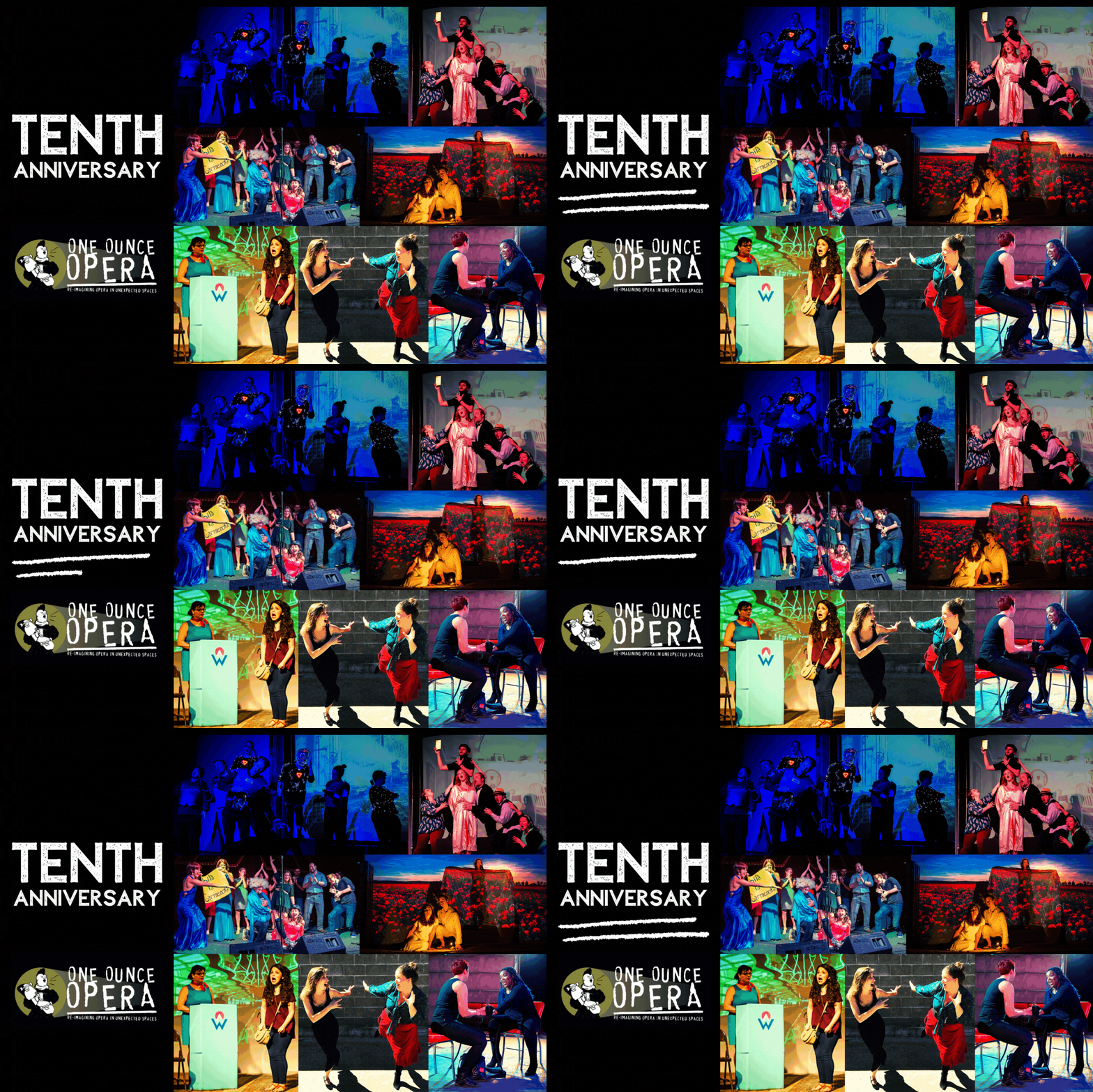
Tenth Anniversary and Big News
A decade ago tonight, August 23, 2022, in a sexy, sweaty bar on E. 7th Street, One Ounce Opera artists poured their hearts and souls (amid skinned knees and torn zippers) into a raucous, vaudevillian-style showcase that officially launched the company.
In the decade since, we’ve poured ounces of opera into the hearts and souls of our sweet, sweet community. How did we get here?
You. We’re here because you supported the idea of the region’s first micro-opera festival, and then came out despite the ice. Or heat. Or rain. Or cold. You were more reliable than the US MAIL.
You jumped at the chance to drink beer with us while we serenaded and soothed, in lovely gardens or tiny clubs, in living rooms or beer halls.
You brought friends. Or relatives. Or both. And sometimes, those friends became relatives (how many couples met because of OOO?)!
But more than anything, you supported us and our punk-rock hearts, brave enough to boast that “opera isn’t obsolete, popular opinion of opera is.”
And you proved us right time and time again.
And now, with your support, the next ten years will be bigger, better, and brighter, using opera as our vehicle for deepening connection and community.

4th Annual Open Call for SHORT OPERAS!
DEADLINE FOR THE 2018-19 COMPETITION HAS PASSED. WE ARE NOT ACCEPTING SUBMISSIONS AT THIS TIME.
CALL FOR SHORT OPERA SUBMISSIONS!
Composers and librettists: We’d like to formally invite you to submit work to our 2019 Fresh Squeezed Ounce of Opera Competition. Winning pieces will be produced and performed by One Ounce Opera in Austin, Texas, as part of the first – and only – short opera showcase in the state.
This will be the 4th annual Fresh Squeezed Ounce of Opera (FSOO) – the premier short opera showcase of Texas. The popular, award-nominated event celebrates new works and contemporary voices. Creators who identify with a historically underrepresented group (women, people of color, LGBTQ+ folks, etc.) are highly encouraged to apply.
In addition to having works produced, fully staged, and performed in Austin by a cast of professional singers, One Ounce Opera spotlights each composer/librettist in an informative blog post that includes questions from the cast. Each work is highlighted in our newsletter and on social media, and each winner receives a professionally-edited live video and audio recording. At each performance, attending composers/librettists will be acknowledged and awarded a certificate (and some swag).
See composer spotlights and videos from 2018’s 3rd annual FSOO.
FAQ:
Where can I see the official rules for the FSOO competition? Guidelines appear on the entry form. The application link is live between July 1st- September 15th, 2018. Please review the rules in detail before submitting any work. Works that do not fit within the guidelines will not be considered.*
When are the performances? FSOO will be March 22-24 and 29-31, 2019.
 How do I submit my files? On the entry form, you will supply a link to an online folder. We must be able to download the score, libretto, and an mp3 of the work. For accuracy, please convert all text/score files to PDF and all MIDI files to mp3 before sending. Example of what/where to upload and link to: Dropbox folder, Google Drive, YouTube, SoundCloud, other storage methods that can be accessed via link. The required materials are listed on the form. Please note: direct email of materials will not be accepted.
Am I allowed to submit more than one work? YES! As long as each submitted work follows the guidelines of the competition, we welcome multiple entries. Guidelines can be found on the form.
I submitted more than one opera. Could they BOTH be chosen? YES! However, it is highly likely only one would be chosen.
You guys have chosen my work before. Could I enter again this year? YES. Past winners are welcome to submit new work.
How will I know if my work was chosen? Winning works will be announced via Facebook and a post on this site, and the winners will be notified shortly thereafter. Copies of all parts and any revisions will be due at that time.
How do I keep up with any new developments in the competition? For the latest details, we strongly suggest following One Ounce Opera on Facebook, and adding yourself to the Facebook event page. We will add you to our FSOO newsletter, as well.
Once again, when exactly is the deadline? Applications are closed for 2018-19. The hard-and-fast deadline for entry into FSOO was 11:59pm on September 15th, 2018. Only complete applications — with all required materials received as requested by the deadline — will be considered.
I have a question not answered here. How do I get in touch? Click here to send us a message about the competition!
*Note: the competition in 2018-19 is for short operas only. Art songs are not being reviewed this fiscal year.
The Winners: Announcing FSOO 2018 Short Opera Selections
After an international submission process, One Ounce Opera announces Fresh Squeezed Ounce of Opera Selections for 2018. The third annual short opera festival takes place April 6-8 in Austin, Texas at the Museum of Human Achievement.
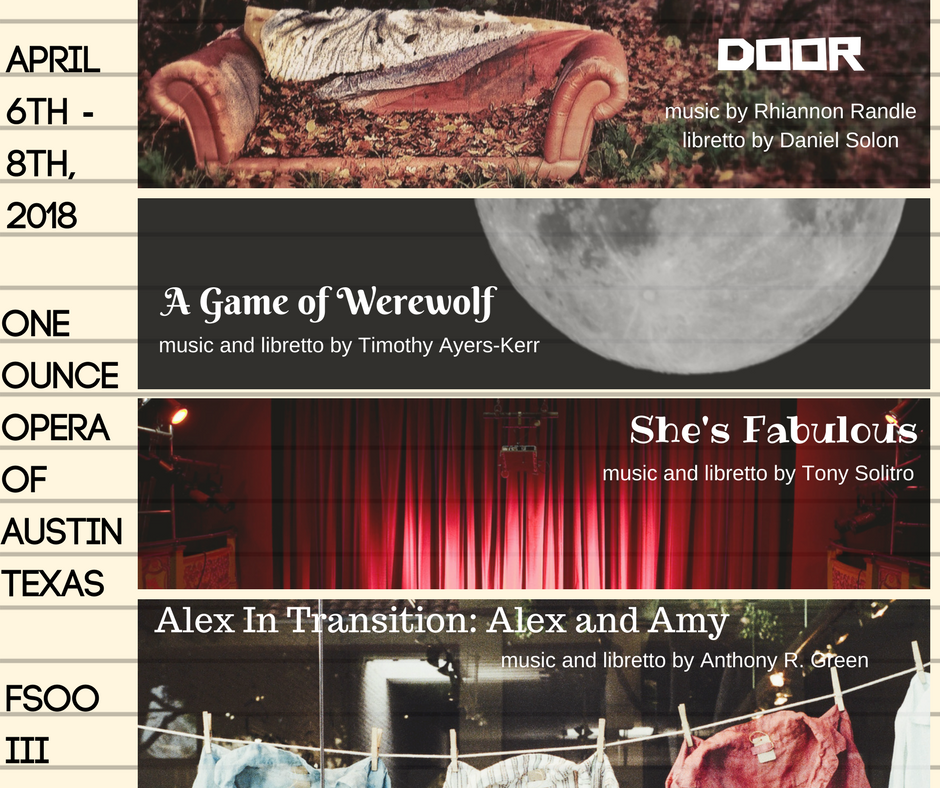
This year’s winning selections are:
- DOOR – music by Rhiannon Randle, libretto by Daniel Solon
- She’s Fabulous – music and libretto by Tony Solitro
- Alex In Transition: Transition II: Alex and Amy – music and libretto by Anthony R. Green
- A Game of Werewolf – music and libretto by Timothy Robert Ayres-Kerr
Directed by Daniel Solon. Produced by Julie Fiore. Collaborative Pianist is Graham Yates. Technical Director is Gus Sterneman.
Sung by One Ounce Opera Members Patricia Combs, Julie Fiore, Dalton Flake, Andy Fleming, Angela Irving, Jake Jacobsen, Robert LeBas, Charissa Memrick, Jenny Ohrstrom, Julie Silva, Julia Watkins-Davis, and Veronica Williams.
Tickets will go on sale soon. Be the first to know — SIGN UP FOR OUR NEWSLETTER!
Follow One Ounce Opera on Facebook, join the Facebook event, and bookmark the FSOO-III page for the latest information on OOO’s flagship series. Cheers!
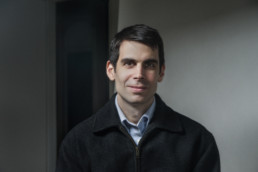
Meet FSOAS '17 Winning Composer Douglas Fisk
We'd like to introduce Douglas Fisk, whose winning song cycle Banjo and Shadows sets Carl Sandburg's stirring poetry in motion. OOO's Jake Jacobsen has been preparing the piece for the 2nd Annual Fresh Squeezed Ounce of Art Song, and had these questions for the composer:
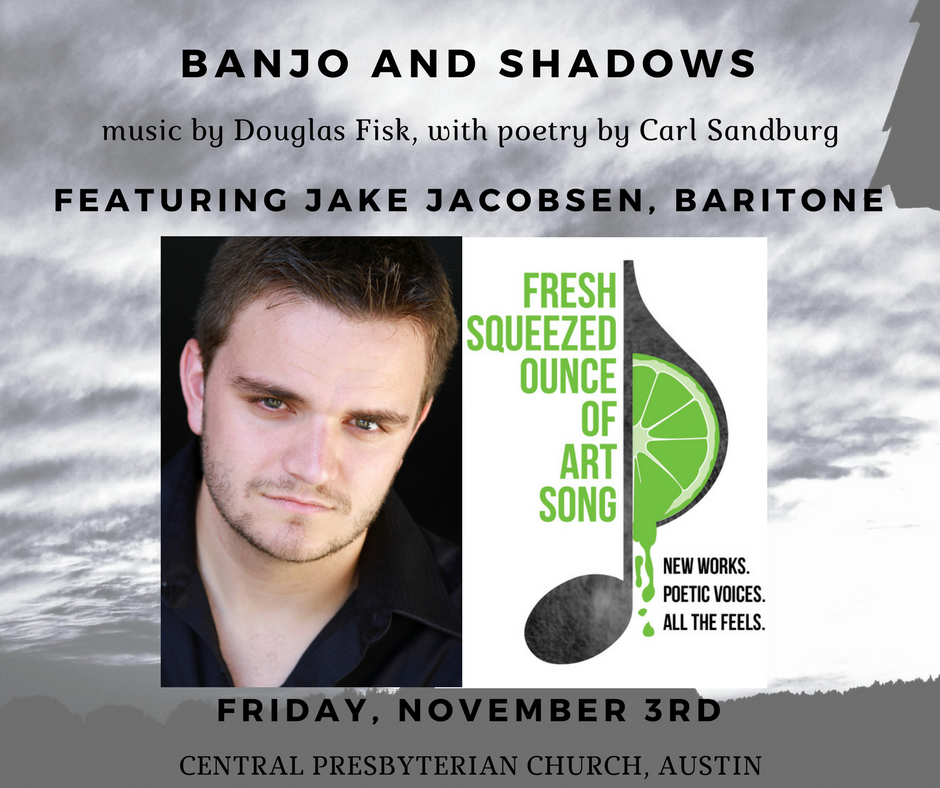 Jake: Sandburg's Chicago Poems compilation must contain at least one hundred poems. How and why did you select the ones you did?
Douglas: I set about finding a series of poems that created a certain dramatic/emotional arc from beginning to end. In terms of selecting one poem over another -- that's largely an intuitive process, whereby a poem either seems conducive to setting or not; it's a little hard to explain, but when you find a poem that works with what you're trying to do, you recognize it. I liked the idea of ending with the “Kreisler” poem, a reference to the great violinist Fritz Kreisler, with the poem’s last lines suggesting a continuation even at the end of the cycle.
Jake: What was the biggest challenge setting these pieces?
Douglas: Setting these poems came relatively quickly once I settled on the poems. The fourth poem used in the cycle, “From The Shore,” required a slightly different approach due to its greater length.
Jake: Have you set Sandburg's texts before? If not, do you see yourself coming back to this poet in the future?
Douglas: Yes, in fact one of the earliest pieces I wrote when starting out as a composer was a setting of five other Sandburg poems from Chicago Poems, titled Sandburg Songs. That was written in 2002. Carl Sandburg was a poet I felt a connection with as I was growing up, and I had a copy of his collected poems that I'd read from regularly. I still feel that connection to his work, so it has felt natural to sometimes revisit his work when I’m looking for poetry to set.
Get your tickets to FSOAS '17 to hear Douglas' work in person!
____
Douglas Fisk is active as a composer, pianist, and teacher. His music has been performed by members of the New York New Music Ensemble, percussionist Gwendolyn Burgett, baritone Malcolm Merriweather, and Sospiro Winds. He has studied composition with Paul Barsom, Bruce Trinkley, Ezra Laderman, and Martin Bresnick. He received his MM and MMA degrees from the Yale School of Music. He has attended the Oregon Bach Festival Composers Symposium, the June in Buffalo festival, the European American Musical Alliance program in Paris, France, where he studied with Claude Baker, and been in residence at the Millay Colony for the Arts.
To find out more about Douglas, visit his website http://douglasfiskmusic.com.
Meet FSOAS '17 Winning Composer Kevin March
On Friday, November 3rd, One Ounce Opera will premiere an important piece -- Songs of Remembrance and Resistance -- at the 2nd Annual Fresh Squeezed Ounce of Art Song. OOO soprano Amy Selby, along with Veronica Williams, will perform the song cycle. Let's hear about it from Amy and composer Kevin March now.
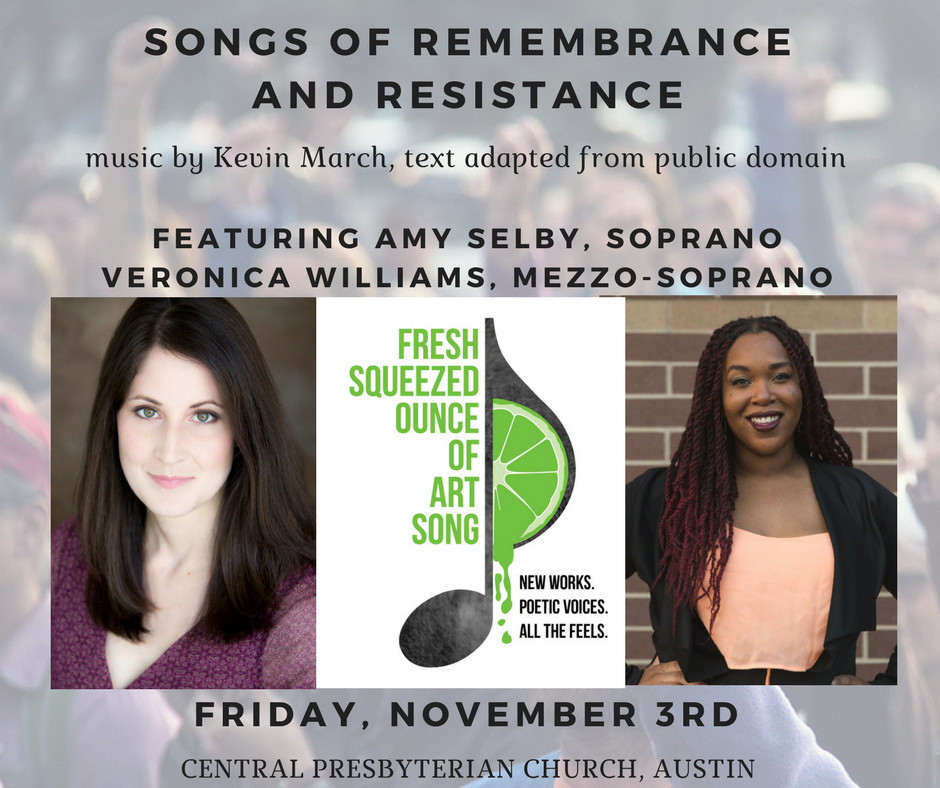 Amy: It will be a pleasure to perform your pieces from your set at One Ounce Opera's Fresh Squeezed Ounce of Art Song in a few weeks!
You mention in the score that, "Principled women taking principled action in the face of patriarchal warnings, persisting in spite of fear, harm or threat of harm, are to be found throughout recorded history and across cultures." Out of all of the women in history, what was it about these particular women that influenced you to choose to group them together in this set?
What composers, one living and one from the past, have had the most impact in helping you form your own style of composition? What particular features from their works inspire you?
Kevin: It’s a pleasure to have had my cycle chosen for the concert and to have it in your capable hands, or rather, voice. Thank you also for the thoughtful questions.
As to why I chose these particular women for the cycle: to put it quite simply, they saw one thing that was within their power to do and they did it. “I will save this life.” “I will resist this injustice.” “I will not accept this behaviour.” I found it remarkable that, for these women, their extraordinary responses seemed, to them, the obvious thing to do. That's both challenging and inspiring. I should also add that I have three more songs in various stages of completion, which will be added to the cycle later.
As for composers who’ve had an influence: with respect to my vocal music, the American composer William Bolcom, with whom I studied while I did my Masters and Doctorate at University of Michigan, and Claude Debussy are probably my biggest inspirations. Both are masters of text setting; both brilliantly employ every musical element to convey the text.
Experience Songs of Remembrance and Resistance on Friday, November 3rd!
_____
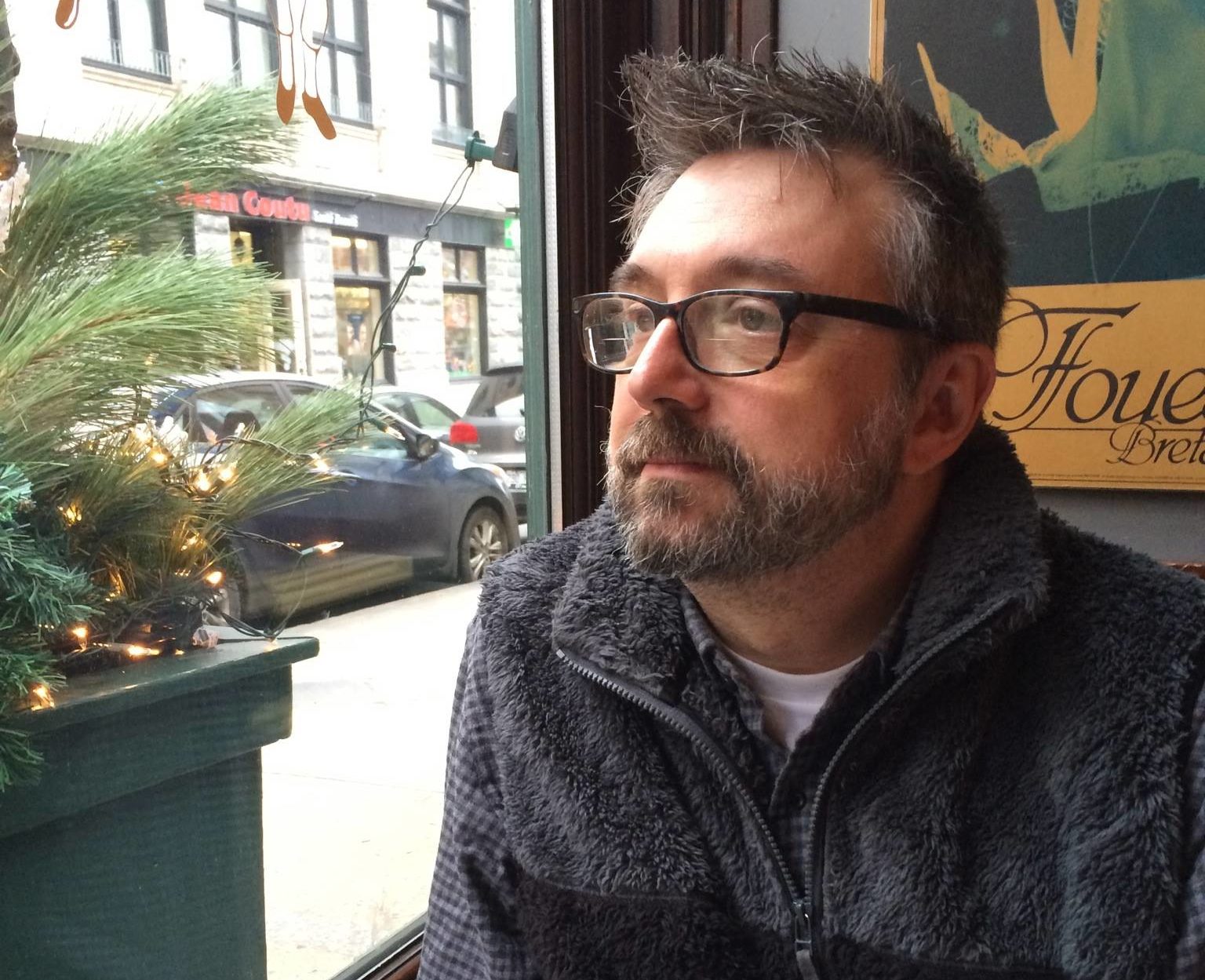
Kevin March is an award-winning, composer who’s works have been performed in North America, Australia, an Europe by Opéra de Montréal, Pacific Opera Victoria, the Tasmanian Symphony Orchestra, Orchestra Victoria, the New York City Opera, and numerous chamber ensembles and soloists.
His works have been featured in the Metropolis New Music Festival and the 7th Sydney Biennale. Awards include first prize in the 3MBS National Composer Awards for his orchestral work Kambarang and the Dorian La Gallienne Prize for Ophélie. His works have been broadcast on radio and featured in the ABC National documentary Modern Muses: The Greeks and New Music.
His opera, Les Feluettes (Lilies), commissioned by Opéra du Montréal premiered to sold-out audiences, standing ovations, and rave reviews in May 2016 and was subsequently nominated for a coveted Opus Award. It’s second production with Pacific Opera Victoria in April 2017 saw more full houses and standing ovations. The Edmonton Opera will give Les Feluettes its third production in 2017.
To find out more about Kevin, visit his website www.kevinmarch.com.au.
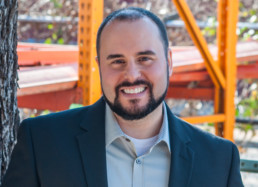
Meet FSOAS '17 Winning Composer Steven Serpa
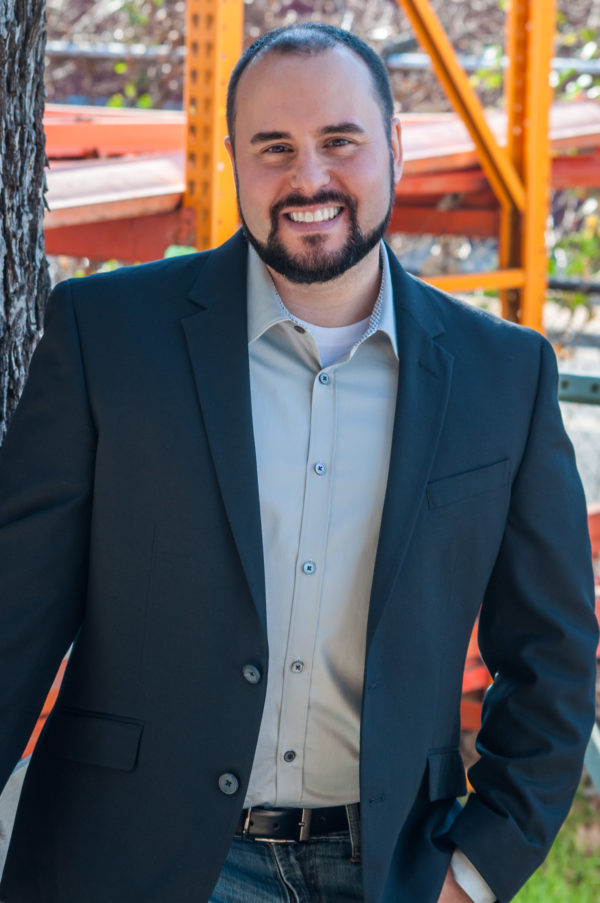
Welcome back 2-time FSO winner Steven Serpa, Austin-based composer and singer. His winning short opera Thyrsis and Amaranth made the 2016 Fresh Squeezed Ounce of Opera program, and has been hailed as "powerfully emotional" and "truly beautiful....a magnificent story." Maureen, who played Amaranth, takes on Serpa once again, and along with OOO newcomer Chelsea DeLorenz, will breathe life into Steven's quirky song cycle The Creatures: A Bestiary Retold on Friday, November 3rd.
And now, with the help of Maureen and Chelsea, let's spotlight Steven and his work. Enjoy!
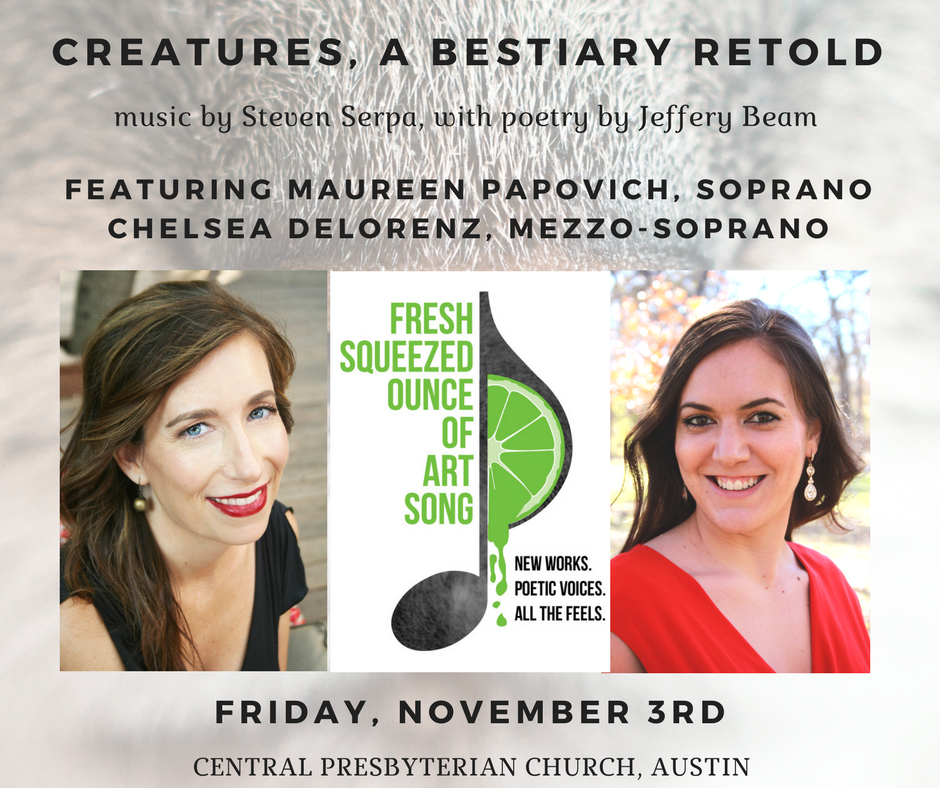 Maureen: I'm absolutely loving these pieces. I think my favorite thing about these songs is how dark parts of them are. So many songs about animals are cute and funny. I love how the poetry and music reflect a truer portrait of living beings (even the fantasy ones!)
Anyhow, a couple of questions for you about your process with these pieces.
1. An obvious one is, how did you choose these particular 'beasts' to set?
2. I'm also curious what drew you to Jeffrey Beam's poetry to begin with. You speak in the notes about your relationship with Lee Hoiby - which is so interesting - and you talk about your love of Beam's poetry, but not how you came to find his work and what about it moves you?
Steven: Hi Maureen & Chelsea! I’m glad to hear from you and glad you’re enjoying the beast songs. I’m really looking forward to hearing what you do with these songs. After wrestling with the notes and rhythms on the bars of the music/cage, I’ve grown fond of these little monsters. Whether spikey or fuzzy, each animal has its beauty and light, their ugliness and darkness. I also think the Prologue is one of my favorite vocal things I’ve written! I’m looking forward to this.
So 1st, these little monsters…
The Creatures is a work I have wanted to write for a bunch of years now. The poems are such entertaining gems. They are quirky mixtures of “scientific observation” and mysticism that Jeffery crafted from snippets of Elizabethan bestiaries. While Jeffery drew on the tradition of these medieval authors, I drew on the tradition of beast songs from the last century. So why did I choose the creatures I did? Some of the creatures I chose because composers before me had written really great works on them, like Poulenc’s Le Dromadaire or Cage’s Litany for the Whale. The others I was drawn to for the combination of myth and reality or of their beauty or power. Each creature has two sides, like all of us really: the Beaver has its sweet, playful quality but is also a crafty creature of the night– the Manticore is a dangerous man-eater with a radiant, clear voice.
So 2nd … What is it about Jeffery’s poetry…
The Creatures is actually my third work with Jeffery’s poetry. Last year the Austin Symphony Orchestra premiered my work An Invocation, a tone poem inspired by his poem of the same name. But the first time I came across his texts was in 2008 when I was writing a choral cantata for a World AIDS Day benefit in Boston. I was looking for text that possessed both memorial qualities but was also uplifting, and I found this absolutely perfect and inspiring poem:
Heaven’s hounds guard your ashes now
Shine their green light
on a humbled earth
For every gray stone
alive with moss and left
unturned by your kind feet
Heaven’s birds sing
That was my intro to Jeffery Beam’s work. Since then, I’ve extensively explored his poetry. It has inspired me and had me scheming new partnerships between his text and my music. On top of that, learning that Lee Hoiby, one of the best art song composers in the history of American song, learning that he had set Jeffery’s texts made me feel even more connected to the poetry. Lee was an early mentor to me. When I first started composing, he graciously looked over my songs and gave me words of criticism and support. I feel like these songs are a spiritual return to those early songs, and so I’ve dedicated them to Lee Hoiby’s memory.
Hear The Creatures come to life on Friday, November 3rd at 8pm!
_____
Steven Serpa is a composer whose music has won recognition with ensembles and opera companies across the United States, Canada and Europe. His work An Invocation was recently premiered by the Austin Symphony Orchestra and featured on the TreeFalls new music series in Spartanburg, SC. His one-act opera Thyrsis & Amaranth was premiered by Hartford Opera Theater in 2011 and has since been produced in Halifax, Cincinnati, Austin, St. Louis, and recently at Syracuse University. Critics praised Thyrsis as "Truly beautiful… a magnificent little story jammed full of thought and feeling and meaning" with “gorgeous music and wrenching lyrics.”
To find out more about Steven, visit his website http://serpamusic.com.
Meet FSOAS '17 Winning Composers Rodney Rawlings and Michael Scherperel
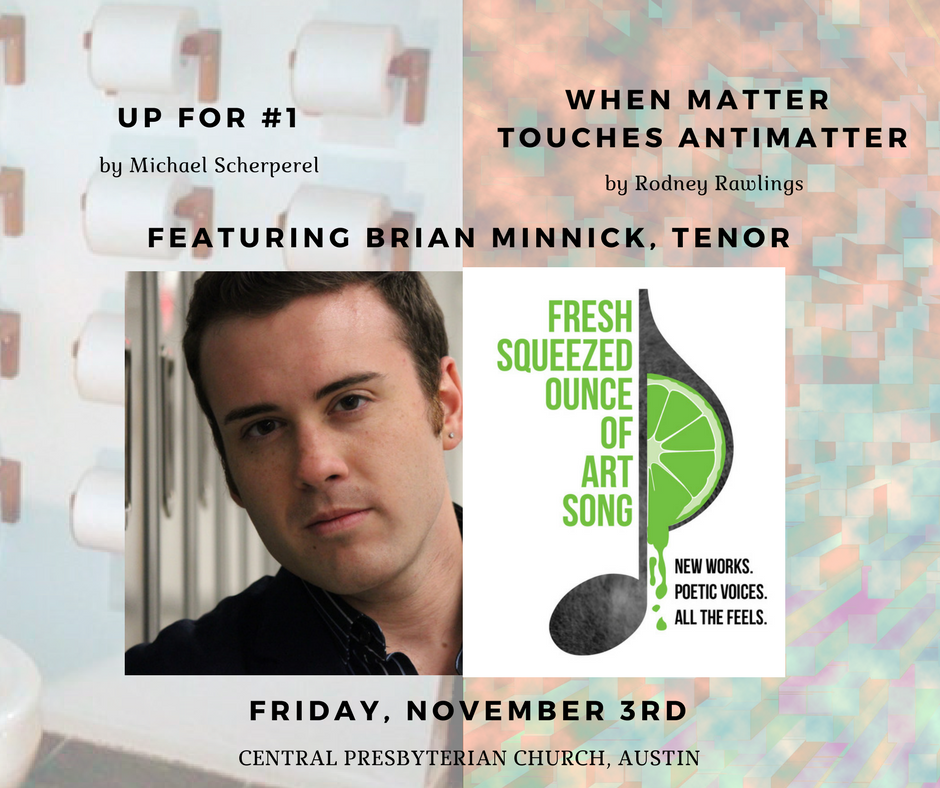
OOO's newest tenor, Brian Minnick, joins us to showcase two short songs by two contemporary composers, whose works prove inspiration can happen in places you least expect. Introducing When Matter Touches Antimatter by Rodney Rawlings and Up for #1 by Michael Scherperel! Here them premiere in Austin on Friday, November 3rd. Brian had these questions for the winning composers:
 Brian: Rodney, most composers set their music to the poetry of other writers. What is it like to set your own text to music?
Rodney: Actually, with me the melody always comes first and I write the words to it. A few times, as in my “Ave Maria (Ellen’s Prayer),” I have taken a famous poem as my basic text, but I always freely adapted the words to the music, preserving the feeling and theme, sometimes adjusting the music a bit but keeping the melody’s integrity.
When I write lyrics, often the words come easily at first; but gradually the constraints of rhyme scheme, the effect I wish to preserve, and melody paint me into a corner toward the final cadence, and I am racking my brains to express all I want to within my set musical phrases. If no inspiration comes, I am occasionally forced to change the melody or structure of the song.
Brian: When Matter Touches Antimatter as some really nice jazzy moments. What styles of music inspire you and your writing?
Rodney: Thank you! Concerning categories such as jazz, classical, pop, etc., I have no preferences. I learn from and am passionate about individual works no matter what the style. I’ve analyzed scores by Beethoven, Wagner, Chopin, Bizet, and others. In this connection I must mention Franz Lehár, my first encounter with whose work in Lovro von Matačić’s recording of DIE LUSTIGE WITWE was what started me in composing. Lehár’s mastery of melody in that operetta electrified me, and also led me to a deeper appreciation of the arranger’s art.
To use the term “style” in another sense, I am partial in my own songs to styles that express yearning and reverence for the things of this Earth, such as the fugitive slave’s ordeal in my “Take Me, O St. Lawrence River (Freedom)” and the astronaut’s quest in my “To Venus and Mars.”
In others’ work, I love and study aspirational songs like “When You Wish upon a Star,” “The Wayward Wind,” and “The Long and Winding Road” and dramatic songs like “Love Is a Many-Splendored Thing” and “Dein ist mein ganzes Herz.” But the music has to be right, irrespective of the theme or style. “Silver Threads and Golden Needles,” a country song, fills me with admiration for its concept and execution.
Brian: Michael, there must be a great story for the origin of this song. Would you mind sharing it?
Michael: This rather silly song was fun to write and DavidMichael Schuster (the David of the dedicatees) and I had a blast performing it. The other dedicatee, by the way, is Eric Stark, Music Director of the Indianapolis Symphonic Choir. Eric posted on Facebook a photo of the brass plaques posted next to some new toilets on the campus of Butler University and dared—jokingly, I think—his composer friends to write a song using the words. So I did!
Brian: The quick meter changes throughout give a very unique flow to the piece. What inspired you to use such different meters?
Michael: I have a bit of a penchant for meter changes. In my vocal writing, I try to let the text dictate that, of course. Such changes, along with asymmetrical rhythmic patterns, can provide a lot of amplification to text. It’s my intention—whether always fully realized or not may be another question!—to underscore some aspect of the words, whether to slow them down for emphasis or speed them up for tension. I recently conducted a recording of my chamber opera “Thompson’s Luck”, a work in which both odd meters and meter changes figure prominently. You could peruse a redacted score on my website if you’re interested. The role of Steve Thompson is particularly rife with not only rhythmic angularity but also melodic tension—lots of 7ths and 9ths—since these compositional tools seemed to me to best reflect the man’s character.
Don't miss these songs! Get tickets for the 2nd Annual Fresh Squeezed Ounce of Art Song!
____
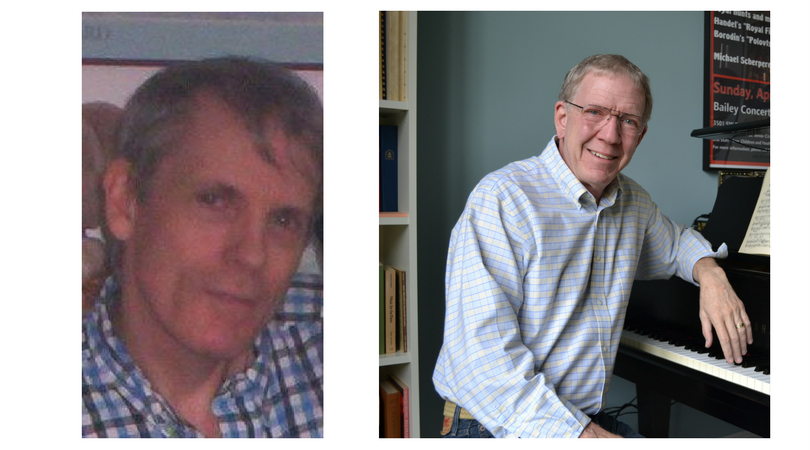
Rodney Rawlings, a Torontonian, has had his art songs and concert band pieces performed in Toronto; in Chicago; in Chautauqua, New York; in Geneva, Illinois; in Elgin, Illinois; and in Munster, Indiana. He traces his initial passion for art song to an early encounter with Franz Lehár’s DIE LUSTIGE WITWE. Rodney writes the lyrics to almost all his songs, which concern reverence, aspiration, independence, and the future. These themes also occur in those songs for which he has adapted an existing text.
To find out more about Rodney, visit his website https://ca.linkedin.com/in/rodneyrawlings.
____
Michael Scherperel studied composition and conducting at the Eastman School of Music where his principal instrument was organ. He later undertook graduate studies in piano, composition, and conducting at Boston University. He holds a B.A. in chemistry from Harvard and a M. Mus. in accompanying from the University of Miami. Mr. Scherperel has been at various times a vocal coach at the American Institute of Musical Studies (Graz, Austria), chorusmaster and assistant conductor with the Greater Miami Opera (now the Florida Grand Opera), music director of the Broward Symphony Orchestra, and artistic director of the Fort Lauderdale Symphony Chorus. Mr. Scherperel was a founding member of the Miami Chamber Trio and makes frequent appearances in chamber music and vocal concerts.
To find out more about Michael, visit his website www.michaelscherperel.com.